
Nishat Mills Unveils 20MW Solar, 35MWh Battery to Cut Costs
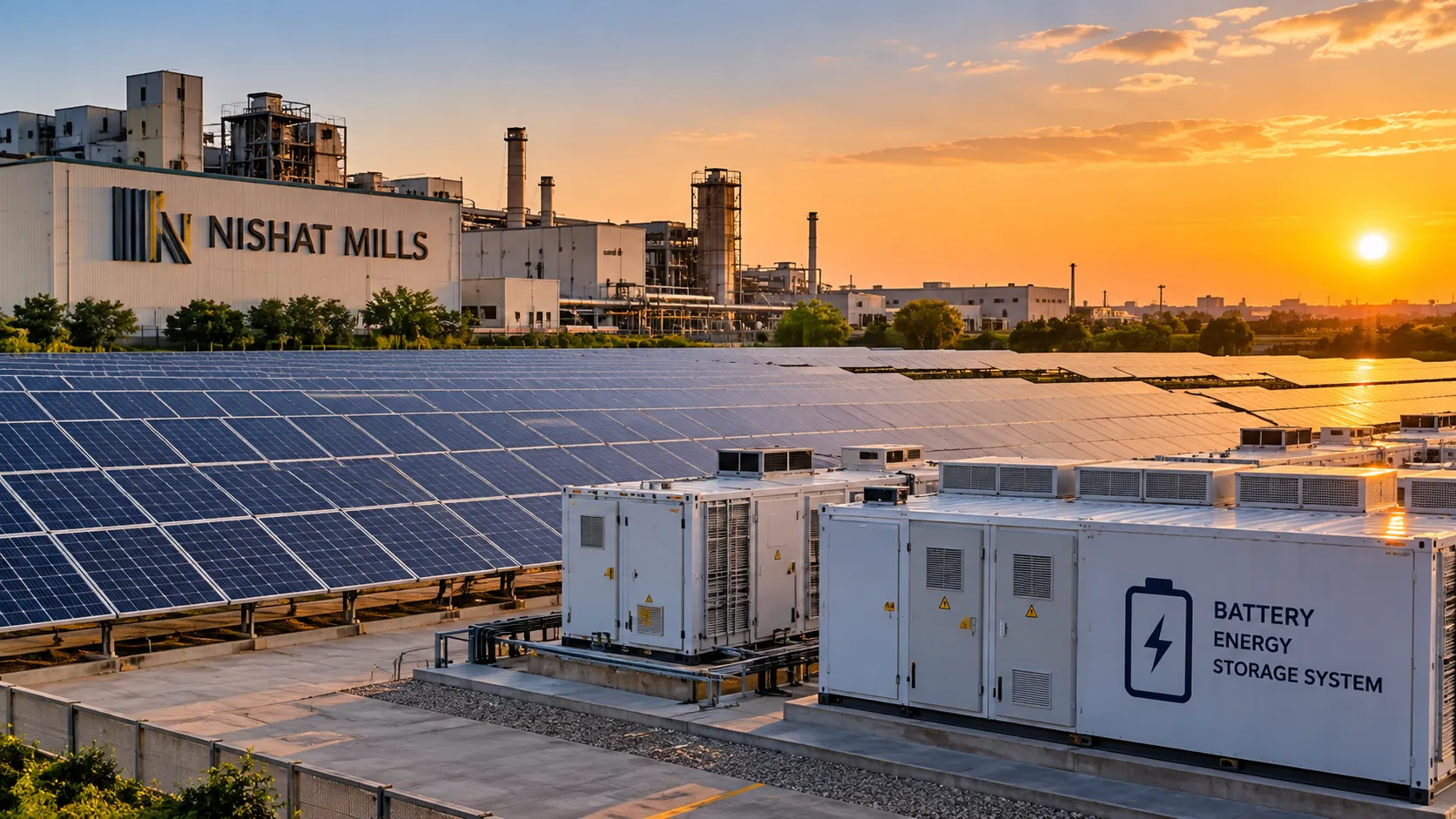
LAHOR: Nishat Mills Limited has turned another renewable-energy plan into a firm project. The textile major disclosed that it has signed an agreement to install a 20-megawatt photovoltaic solar plant paired with a 35-megawatt-hour battery energy storage system at two of its production sites, making a sizeable bet on solar and battery storage as Pakistan's textile industry searches for greater control over energy costs and supply.
The agreement brings together EBR Energy Pakistan (Pvt.) Limited, China's Sungrow Power Supply Co. Ltd. and Pragmatic Engineering Solutions FZE for the supply and erection of the project. Nishat's disclosure doesn't specify how responsibilities divide among the three partners only that all three are party to the deal.
Nishat Mills Solar Project
The project will sit at Nishat's plants in Bekhi and Ferozwatwan, both along the Sheikhupura-Faisalabad Road corridor. The industrial belt that anchors much of Punjab's textile output. The filing doesn't disclose how the 20MW solar capacity or the 35MWh storage capacity divides between the two sites, nor does it state the project's cost.
Also Read: Nishat Mills Exits Dairy Business, Sells Entire Stake To Turkish Partner for Rs5
Nishat expects power generation to begin in March 2027, giving the project roughly six months from disclosure to its targeted generation date, an ambitious timeline for a project combining sizeable solar generation with battery storage.
A 20MW solar plant would constitute a sizeable industrial energy project on its own. The 35MWh battery component, however, makes this agreement considerably more interesting. It gives Nishat the ability to store electricity generated during the day and deploy it later, adding a layer of flexibility a generation-only solar system doesn't have.
Lucky Cement offers a useful benchmark. In July 2025, pv magazine reported that the cement producer was developing a 20.7MW/22.7MWh battery system at its Pezu captive solar plant, describing it at the time as Pakistan's largest industrial energy-storage deployment. Nishat's newly announced system carries a larger energy-storage rating at 35MWh, although Nishat has not disclosed its battery's MW power rating, so the two projects cannot be compared on capacity alone.
Not Nishat's First Move Into Solar
This isn't Nishat's first solar investment. The company reported 38.10MW of installed solar projects in its FY2025 annual report, with another 1.84MW under development and approximately 2.99MW of new solar contracts already finalized. The new 20MW agreement therefore represents another sizeable expansion of an energy strategy already operating at industrial scale.
Pakistan's textile sector has repeatedly flagged energy costs as a competitiveness concern, with manufacturers pointing to industrial tariffs and grid dependence as pressures on export margins. Nishat's latest agreement fits that broader pattern, even though the company's own disclosure frames the project simply as a signed agreement for supply and erection, without stating a motive.
What the March 2027 date does establish is a timeline the market can now watch. Whether Nishat's 20MW solar-and-35MWh storage system reaches generation on schedule and how significantly it ultimately changes the company's energy economics will provide the real measure of an investment that pushes one of Pakistan's largest textile manufacturers deeper into industrial renewable power.





Leave a Reply
Your email address will not be published. Required fields are marked *