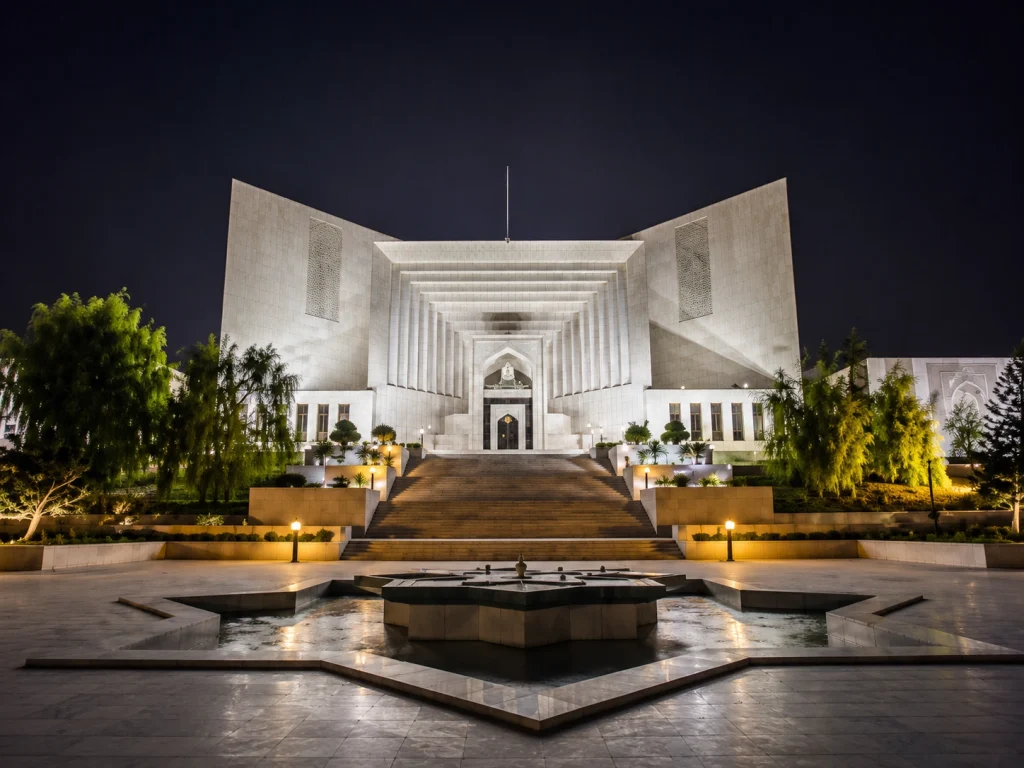
ISLAMABAD: Ruling delivered by the Supreme Court of Pakistan in regards to Pakistan’s wedlock policy that is followed by the federal and provincial government of the country regarding the marriage policy of civil servants states that the couples falling in the ambit of wedlock policy have an ‘expectation of right’ of joint postings which cannot be rejected without a material reason.
The two-judge bench was chaired by Justice Muhammad Ali Mazhar, including Justice Musarrat Hilali, while deciding the appeal petitioned by Naheeda Aziz against the January 17, 2023 verdict by the Punjab Service Tribunal. The 16-page judgment written by Justice Mazhar is now ready to be reviewed by Punjab’s Chief Minister, Chief Secretary, and Advocate General.
Details of the Case of Wedlock Policy of Pakistan
Naheeda Aziz was recruited as an Assistant on BPS-14 scale at Board of Revenue and was posted at Lahore. Her husband, who was also employed in the department of Revenue, served as a clerk in BPS-11 at Faisalabad. Naheeda applied for transfer from Lahore to Faisalabad according to wedlock policy, which allows a married couple in service to be posted at the same place. This was rejected. An appeal she filed before the Punjab Service Tribunal against the order was not entertained.
As pointed out by Justice Mazhar, the denial of a marriage policy transfer application should have some tangible justification behind it, instead of using powers unreasonably, avoiding policies, or causing mental suffering to the applicant by making use of arbitrary decisions. The purpose of the policy was to provide relief from marriage complications.
Technicality Cannot Void Legitimate Expectation
The judgment by the Supreme Court on the wedlock policy in Pakistan created an important precedent that transcends the issue of Naheeda Aziz’s specific case. The court emphasized that good policies formulated in favor of maintaining marriages should not be rendered void through technicalities. Once a competent authority formulates a wedlock policy, there is an obligation on its part to fully follow it for everyone.
“Unless insurmountable reasons exist, a plea of posting the husband and wife at one and the same station should not only be treated with kindness and compassion but should also be dealt with prudently,” ruled the court. It is through such standards, i.e., kindness and compassion as mandatory aspects of the law, that the wedlock policy framework of Pakistan becomes constitutionally based.
ALSO READ: Islamabad High Court Permanently Bans Killing of Stray Dogs
Constitution’s Article 35 Underpins the Judgement on the Wedding Policy
The judgement by the Supreme Court on the wedding policy of Pakistan rested solidly on Article 35 of the Constitution, wherein it is provided that the State shall endeavor to safeguard marriage, family, motherhood, and childhood. The constitutional underpinning provides the judgement with substantial gravity – making it not merely a question of internal administrative procedure, but one of basic human rights.
This ruling particularly emphasized the difficulties faced by the married couple policy Pakistan solves, concerning working women having to balance child care and work obligations in isolation, as they were not together due to posting at separate locations. This is a recognition that puts working women at the core of the constitutional mandate of the policy.
“No Vacancy” is No Longer a Valid Reason
The Supreme Court did not stop wiath just asking for reconsideration of the transfer application of Naheeda Aziz. Rather, the ruling stated that even in case no vacancy exists at the posting place of the husband, steps should be taken to accommodate both of them through transfer or deputation to other departments.
As per the wedding policy framework adopted by Pakistan, the court ruled that there cannot be an arbitrary and selective application of the policy in question, whereby the competent authority picks and chooses when to follow the policy at its own will. In case of any ambiguity in such application, the policy should be interpreted in favor of its intended recipients.

Focus Pakistan is an independent digital news and media platform dedicated to delivering credible, insightful, and impactful journalism across Pakistan and beyond. The publication covers a broad range of sectors including business, economy, technology, telecommunications, aviation, automotive, infrastructure, energy, tourism, public policy, and national affairs.
Committed to accuracy, transparency, and editorial integrity, Focus Pakistan combines breaking news coverage with in-depth analysis, feature stories, expert commentary, and research-based reporting. The platform aims to provide readers with timely, factual, and balanced information while promoting informed public discourse and responsible journalism.
Through its commitment to high editorial standards, Focus Pakistan strives to be a trusted source of news and analysis for policymakers, business leaders, industry professionals, and the general public.