
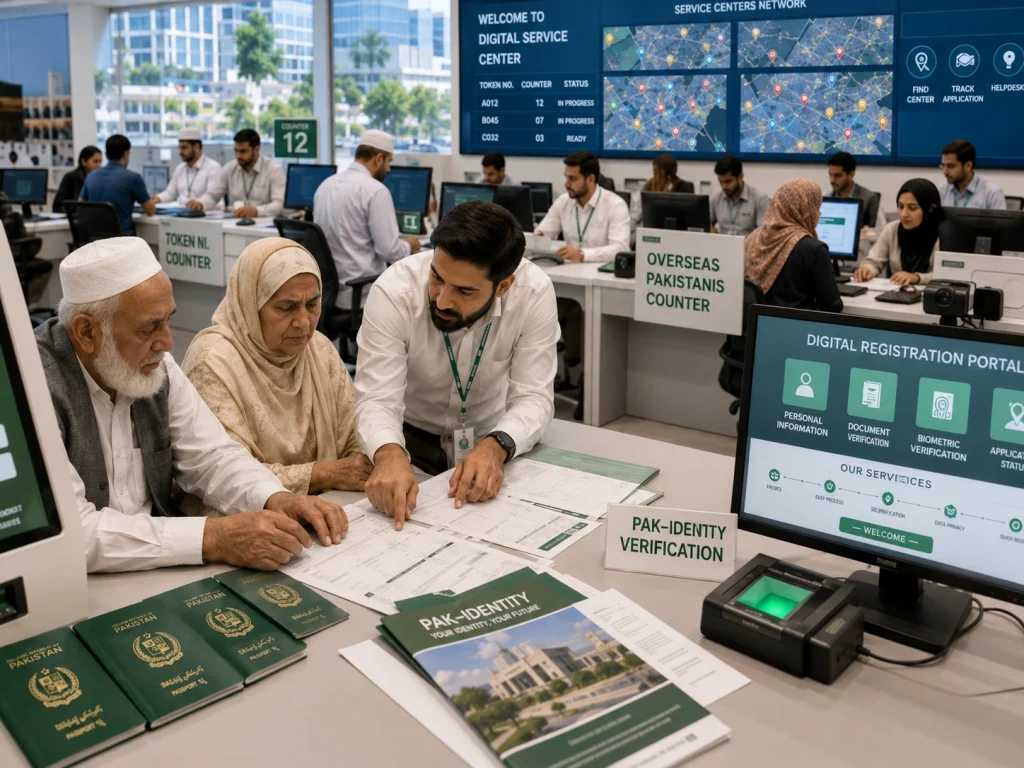
From Punjab to Gilgit Baltistan, Pakistanis have flocked in numbers to enroll in Hajj from the safety of their own houses. These are precisely those who registered, their origin, and the option they chose.
The online registration for Hajj in Pakistan has made a remarkable achievement in just eleven days. As per the figures of the Ministry of Hajj, over 200,000 people have registered their Hajj from their homes within this period, which is a notable achievement for the digital registration system that has been developed to make the Hajj registration process paperless.
The numbers indicate real excitement about the online Hajj registration program by the pilgrims of all provinces and territories of Pakistan in just eleven days.
Registration in Practice
The Hajj registration program through online means employed two separate digital media, and the ratio of their use shows some preference in terms of platforms by the pilgrims from Pakistan. The web portal was used for registration by an overwhelming majority, as there were 180,000 pilgrims using it to register. 24,000 registrations occurred via the mobile application, thus taking the total number of digital registrations beyond 200,000.
The predominance of the web portal over the mobile application implies that internet usage from desktop/laptop computers is still preferred way for Pakistani pilgrims despite the growth of smartphone penetration into the country’s market.
Comparison between Government Hajj Scheme and Private Hajj Scheme
Apart from the division of the communication channel used, the online registration of the Hajj data shows that there is a distinct choice made by the pilgrims between the two Hajj schemes. Over 154,000 pilgrims chose the government Hajj scheme, whereas nearly 49,000 pilgrims preferred the private Hajj scheme. The popularity of the government Hajj scheme among most Pakistani pilgrims is attributed to its reputation and lower price rate.
Province-wise Analysis
The distribution of the number of online registrations for Hajj on a province wise basis is very much in line with the distribution of the overall population of Pakistan, where the largest province of Punjab has topped the chart by a large margin.
Punjab registered 95,000 online registrations and thus made up 46% of the total number of registrations of Pakistan. Sindh came in second place in terms of number of registrations at 63,000.
ALSO READ: Hajj 2027 Registration Opens Today Under First-Come, First-Served Policy
Presence of Smaller Regions
Apart from the four prominent regions, the data on online registrations for Hajj pilgrimage indicates the significance of even the other regions of Pakistan too. Balochistan had 5,500 registrations, which is a lower number compared to the others but is still an important part of their contribution considering the difficulties they face in using centralized technology.
Gender Distribution Within the Registered Hajj Pilgrims
The online registration process for Hajj also provides us information regarding the distribution of genders within the pool of registered Hajj pilgrims. Out of the total number of registered pilgrims, 119,000 belong to the male gender while 84,500 belong to the female gender. The distribution of genders within the pool is such that the males constitute about 58% of the total registrations while the females constitute the rest of the 42%.
Meaning of the Milestone
The milestone of 200,000 registered in the span of only eleven days after Hajj registration was made available online is indicative not only of the extent to which the citizens of Pakistan wish to perform Hajj but also of the increasing recognition of the use of technology in government procedures for something that is considered to be one of the most important tasks in the life of millions of people in Pakistan. By registering from home, the logistical and financial hurdle of traveling to office has been eliminated.
As registration is still underway after these eleven days, the final number is bound to be far greater than this.

Nayab Fatima is a media professional specializing in fact-based journalism, research, and analytical reporting on technology, telecom, aviation, and automobiles.