
Pakistan Unveils Supersonic “SMASH” Missile Threat to Carrier Fleets
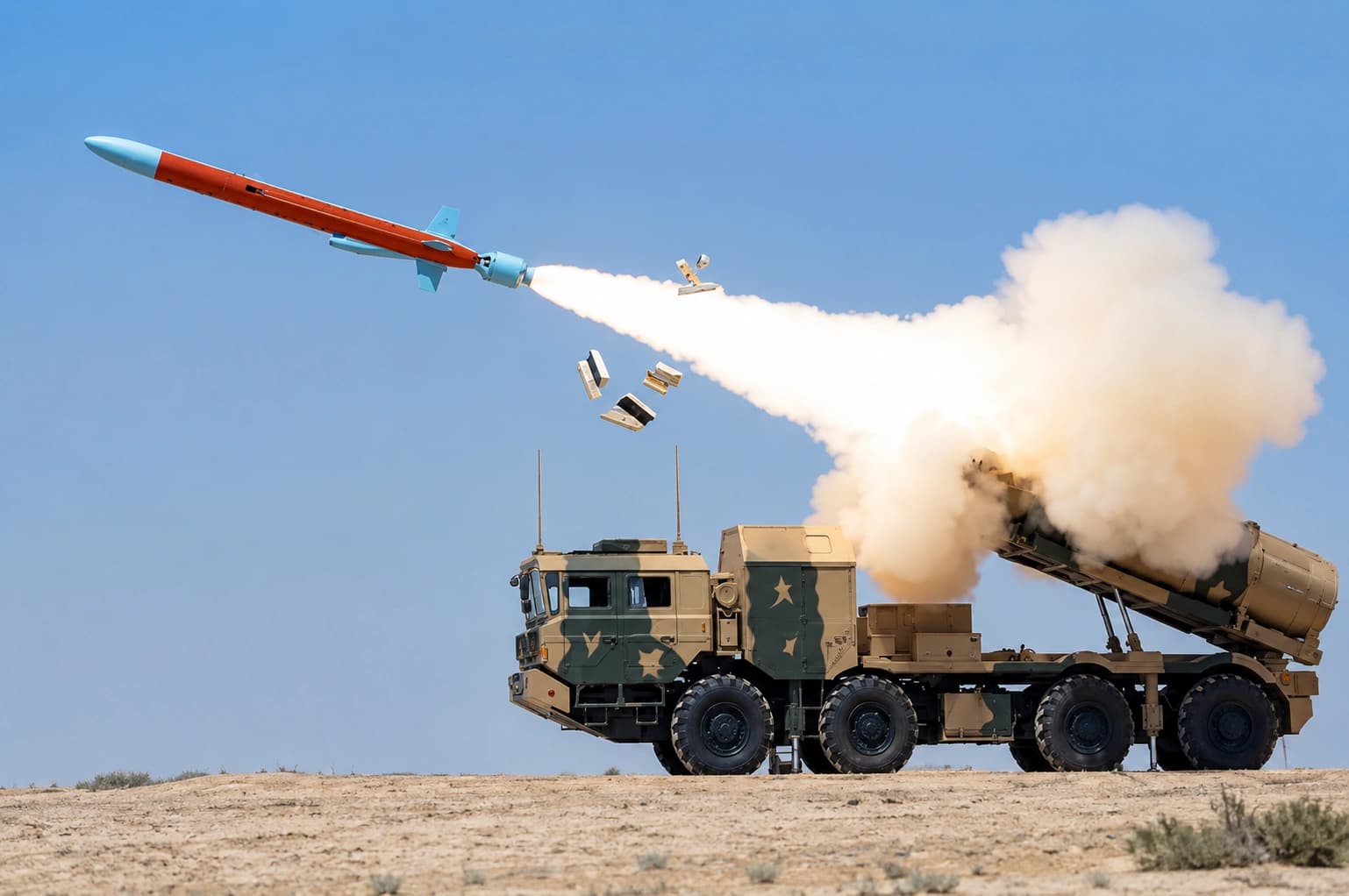
KARACHI: Pakistan Navy just redrew its maritime strike boundary in the Arabian Sea. The Phase II expansion of its Coastal Defence Batteries program built around the indigenous P-282 "SMASH" Anti-Ship Ballistic Missile pushes Pakistan's maritime denial envelope well past 500 kilometres, forcing rival naval planners to recalculate the operational risk of entering the northern Arabian Sea.
This is not a paperwork upgrade. Pakistan's Maritime Technologies Complex in Karachi developed the P-282 ground up for one purpose: destroying high-value naval targets, including carrier strike groups, before they can threaten Pakistani waters.
What the P-282 "SMASH" Actually Does
"SMASH stands for 'Supersonic Missile Anti-Ship,' and that is what it does," writes the author. The SMASH was designed by MTC Karachi using a solid fuel rocket engine, which enables its quasi-ballistic trajectory followed by maneuvering in high speed during the terminal attack phase at an almost vertical dive and estimated speeds of Mach 2 to Mach 2.5.
Also Read: Pakistan’s Military Spending Jumps to $11.9bn After 2025 War — India Hits $92bn
That terminal profile matters enormously. Naval intercept systems optimise for threats arriving at low angles. A missile plunging nearly vertically at supersonic speeds collapses the engagement window for ship-based defence batteries and forces simultaneous demands on radar tracking, fire control, and interceptor allocation.
The guidance package comprises a midcourse flight inertial navigation system with a terminal-phase active radar seeker that tracks mobile maritime targets; a combination that, according to reports, ensures a circular error probability of less than 10 metres for a ship while in motion. The missile has a warhead of about 384 kg capable of disabling any frigate and damaging a destroyer.
From Ship-Based Launch to Mobile Coastal Site
Pakistan currently employs the P-282 missile from its fleet of Zulfiquar class frigates, Tughril class frigates, and Babur class corvettes. Phase II takes that naval strike asset ashore.
Mobile launcher variants give Pakistan something no fleet of ships can match: dispersal. Coastal batteries scatter across terrain, roads, and hardened positions. Satellite imagery can detect a surface combatant underway; finding and targeting dozens of mobile missile transporter-erector-launchers distributed across Pakistan's coastline demands an intelligence picture few adversaries can rapidly generate under wartime pressure.
Retired Vice Admiral Tariq Qureshi described the expanding defensive envelope as reaching "much deeper into the Arabian Sea", a pointed signal toward Indian carrier operations that historically treat the northern Arabian Sea as manageable operating space.
Why 500 km Changes the Carrier Calculus
Modern carrier strike groups keep their aircraft carriers 200 to 400 km from contested shores to stay inside viable aircraft range while theoretically outside missile threat envelopes. Pakistan's previous coastal missile systems, operating at roughly 300 km with subsonic profiles, sat near that threshold.
The P-282's extended land-based variant at 500-plus kilometres shatters that comfortable buffer. An Indian carrier group operating what commanders previously considered a safe standoff distance now sits inside Pakistan's strike envelope.
This shifts the strategic math. Striking Pakistan's naval assets or coastline now demands either accepting carrier vulnerability, committing significant fighter escort and electronic warfare support, or pushing the carrier further south which compresses its aircraft's operational reach against Pakistani targets.
Sea-denial doctrine rewards exactly this outcome. Pakistan does not need to sink a carrier; it needs to make a carrier commander's risk calculus expensive enough that the platform stays further away. Range and speed accomplish that without firing a shot.
A2/AD Architecture: The Missile Is One Layer
The P-282 gains its strategic weight from the network supporting it, not from the missile alone. The Phase II capability of Pakistan incorporates coastal surveillance, naval reconnaissance, over-the-horizon targeting links, and multiple layers of command-and-control structures to form a kill chain and not just a launching vehicle.
For that targeting system, the constant presence of radar surveillance along with either aircraft/satellite cueing or datalinks is essential for determining target information that must be transmitted to mobile launchers before the ship could maneuver out of the kill zone. The development of such a targeting sequence will determine the success of the P-282 missile.
The program also accelerates Pakistan's push away from imported strike technology. Domestic development through MTC Karachi builds sovereign production capacity that international sanctions or export restrictions cannot easily disrupt, a direct lesson from how Pakistan's defence industry interpreted the geopolitical pressures of the past two decades.
Strategic Focal Points: Gwadar, Karachi, and Sea Lanes
The coastal defense considerations of Pakistan fall primarily into three nodes: Gwadar, Karachi, and the sea lines leading to these two harbors. Gwadar is located along the China-Pakistan Economic Corridor and is a multi-billion dollar investment for infrastructural development which could easily be threatened by any hostile naval force. Karachi handles roughly 60 percent of Pakistan's total trade volume. Disrupting either port would inflict economic damage that no strictly military engagement replicates.
Placing 500 km-class supersonic missiles on mobile platforms distributed across Balochistan's coast and Sindh's littoral zone creates concentric threat rings that any hostile surface group must penetrate before reaching either port adding cost, attrition risk, and political weight to any decision to escalate.
| Specification | Detail |
| Full Name | Supersonic Missile Anti-Ship (SMASH) |
| Designation | P-282 |
| Type | Anti-Ship Ballistic Missile (ASBM) |
| Developer | Maritime Technologies Complex, Karachi |
| Propulsion | Solid-fuel rocket motor |
| Official Range | 350+ km |
| Extended Land Variant Range | 500+ km (reported) |
| Terminal Speed | Mach 2–2.5+ |
| Flight Profile | Quasi-ballistic with maneuvering terminal phase |
| Terminal Attack Angle | Near-vertical descent |
| Guidance | INS mid-course + active radar terminal seeker |
| CEP | Below 10 metres (estimated) |
| Warhead Weight | ~384 kg |
| Warhead Type | High-explosive / Improved Conventional Munition |
| Length | ~9 metres |
| Diameter | ~85–90 cm |
| Ship Platforms | Zulfiquar-class, Tughril-class frigates; Babur-class corvettes |
| Land Variant | Mobile coastal launcher (Phase II deployment) |
| Service Status | Operational testing and early deployment |
Deployment charts for the aircraft, technical data and purchasing numbers have not been provided by Pakistan. Information on the existence of the P-282 has been published based on information coming from Pakistani military officials, which has yet to be verified through testing.
Political statements surrounding the program use language designed to project deterrence. The gap between deterrence messaging and verified operational maturity is a distinction every honest analyst must maintain.
The message sent out through the Phase II program is the strategic focus of Pakistan: mobility, survivability, indigenously produced, and extended range. It will be important to see how well the P-282 works during wartime depending on its targeting capabilities, its seeker’s performance against maneuvering vessels, and survivability of the kill chain. The direction is clear. The distance between announcement and operational reality still requires scrutiny.
The Pakistan Phase II Coastal Defence Batteries system, which centers around the P-282 SMASH Anti-Ship Ballistic Missile, is a tangible manifestation of Pakistan’s evolving maritime denial capability in the northern Arabian Sea. Moving from 300km range subsonic capabilities to 500+km supersonic missiles deployed via mobile land-based batteries increases the potential range of threat significantly for any naval vessels approaching Pakistan's coastline.
The operational complexity faced by Indian aircraft carrier task forces in the Arabian Sea just got more complicated. For Pakistan, extending deterrence through precision and mobility rather than fleet size is precisely the doctrine its strategic budget can sustain.





Leave a Reply
Your email address will not be published. Required fields are marked *