



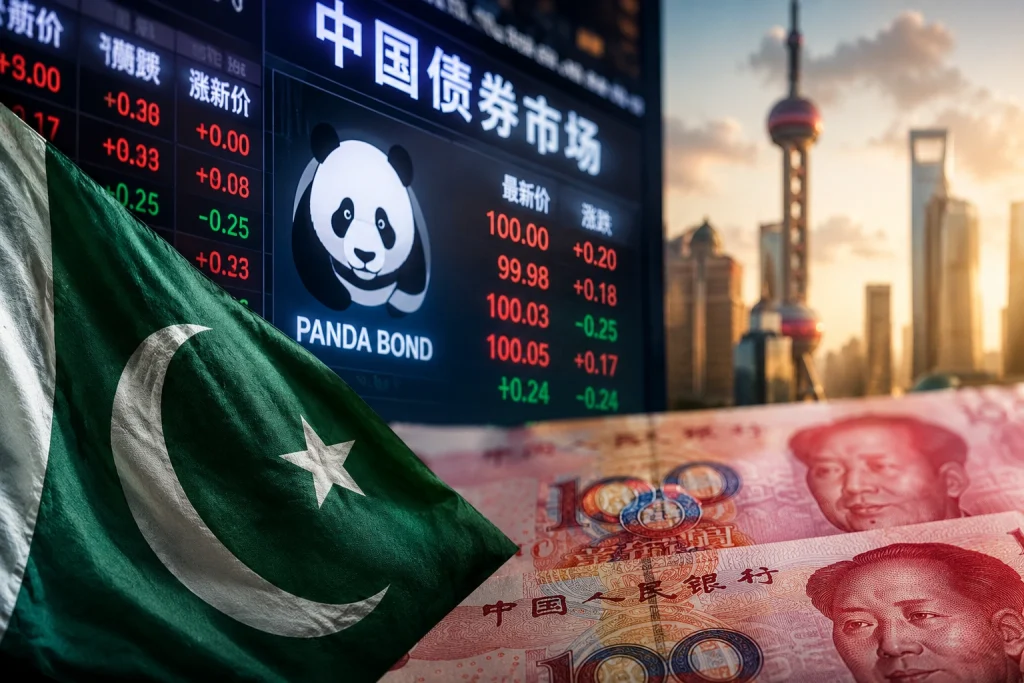
ISLAMABAD: Pakistan is days away from a landmark financial milestone. Finance Minister Muhammad Aurangzeb announced on Saturday that the country will enter Chinese capital markets for the first time through a yuan-denominated Pakistan Panda bond, a move that signals both ambition and urgency as the nation fights to stabilise its economy.
“God willing, next week you will hear good news that for the first time, we will be accessing Chinese capital markets through Panda bond,” Aurangzeb told reporters at a press conference.
Pakistan Panda Bond: A $250 Million First Step Into China’s Market
Debut issue is pegged at $250 million, and this will form part of a larger $1 billion program that Pakistan intends to launch in phases. There will be two organizations from the field of international development, which will act as the guarantors for the bonds, making the instrument credible enough to attract Chinese investors that do not have much knowledge about Pakistani sovereign debt.
Also Read: Pakistan Forex Reserves Hit $20.6 Billion as SBP Reports Weekly Increase
Panda Bonds are foreign debt instruments issued in renminbi by non-Chinese issuers in mainland China. Pakistan joining this market opens a new funding channel beyond the traditional Western financial system and deepens its economic ties with Beijing its largest bilateral creditor and strategic partner.
Economy Exhibits Stability amid Regional Upheavals
Aurangzeb painted a rather positive outlook about the economy’s future. This was evident from an increase in the number of exports along with remittances despite tough times faced by the country from an external environment point of view. The conflict in Iran and the blocking of the Strait of Hormuz have caused disruptions in the import of fuel and gas.
The Panda bond announcement arrives on the back of a significant International Monetary Fund disbursement. The IMF recently released approximately $1.32 billion in fresh funding through two separate loan tranches under its ongoing programmes with Islamabad providing critical breathing room for foreign reserves.
Pakistan is also struggling with a financing deficit worth billions of dollars. As revealed by Aurangzeb, the government is considering Eurobond offerings and commercial borrowings to replace a $3.5 billion facility from the United Arab Emirates. Separately, Saudi Arabia has agreed to provide $3 billion in additional support another pillar in Pakistan’s effort to shore up its external accounts.
Why This Bond Matters Beyond the Numbers
The Panda bond is not just a financing tool it sends a strategic signal. Diversifying away from dollar-denominated debt reduces Pakistan’s exposure to currency risk and Western financial market volatility. It also reinforces the China-Pakistan Economic Corridor (CPEC) relationship with a financial dimension that goes beyond infrastructure loans.
If next week’s issuance lands successfully, Pakistan could become a regular presence in Chinese capital markets and that changes the country’s financing calculus for years to come.

Focus Pakistan is an independent digital news and media platform dedicated to delivering credible, insightful, and impactful journalism across Pakistan and beyond. The publication covers a broad range of sectors including business, economy, technology, telecommunications, aviation, automotive, infrastructure, energy, tourism, public policy, and national affairs.
Committed to accuracy, transparency, and editorial integrity, Focus Pakistan combines breaking news coverage with in-depth analysis, feature stories, expert commentary, and research-based reporting. The platform aims to provide readers with timely, factual, and balanced information while promoting informed public discourse and responsible journalism.
Through its commitment to high editorial standards, Focus Pakistan strives to be a trusted source of news and analysis for policymakers, business leaders, industry professionals, and the general public.