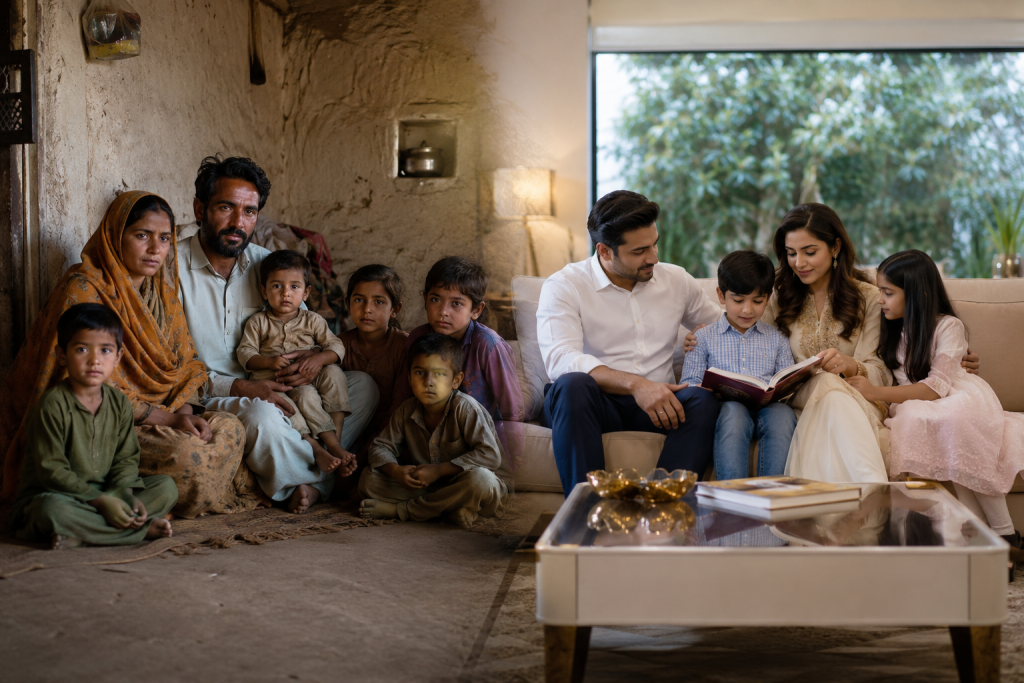
Pakistan family divide trends are becoming more visible as new HIES 2024 data reveals that poorer households continue to have significantly more children than wealthy families across the country.
KARACHI: As the world celebrates the International Day of Families today, May 15, new data highlights why the household remains the undisputed “engine room” of Pakistan’s social and economic landscape.
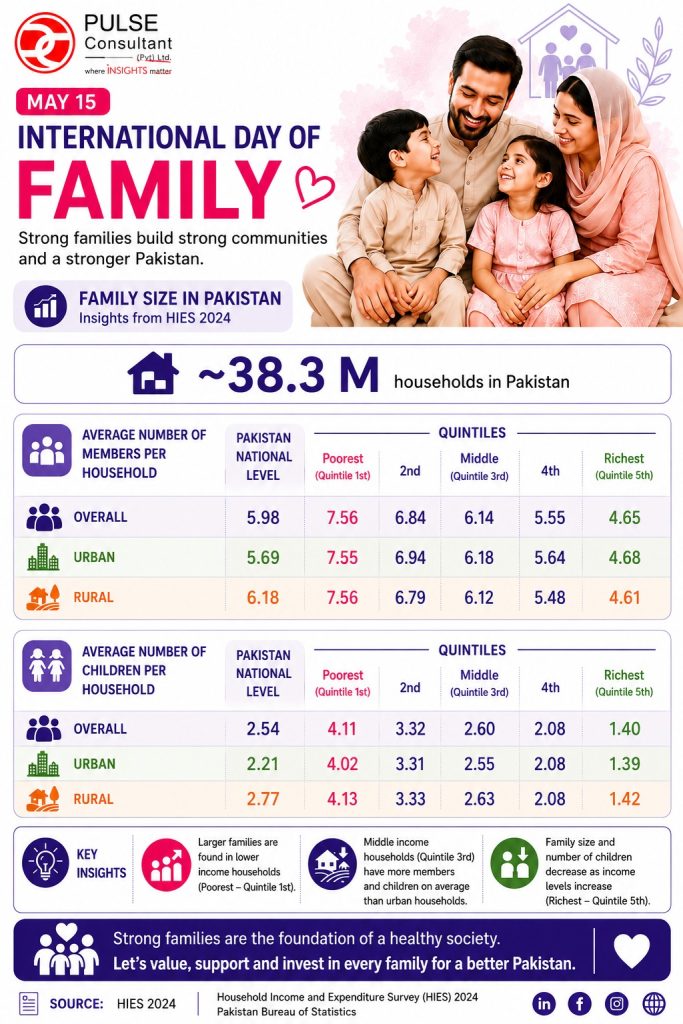
While global trends shift toward individualistic living, Pakistan continues to draw its strength from the collective. Recent findings compiled by Pulse Consultant, a leading marketing research firm, utilizing data from the Pakistan Bureau of Statistics (PBS) HIES 2024, reveal a nation of 38.3 million households where the family unit dictates every major market shift and policy decision.
The figure sounds like a census footnote. It isn’t. It is, arguably, one of the most consequential numbers in understanding where Pakistan is headed economically and who gets left behind getting there.
The national average flattens what is actually a sharp geographic divide. Rural households clock in at 6.18 members on average. Urban ones sit at 5.69. That gap of nearly half a person per household unremarkable in isolation scales into millions of additional dependents when applied across Pakistan’s vast rural population.
More dependents per earning adult means thinner margins for savings, education spending, and healthcare. It means children in rural Pakistan start life sharing resources that urban children even lower-middle-class urban children often take for granted. A school bag. A tutor. A doctor’s visit that doesn’t require selling something first.
The Number That Should Bother Everyone
Here is where the data stops being a policy abstraction and becomes something harder to sit with.
Pakistan’s poorest households average 4.11 children. Its wealthiest average 1.4. Read that again slowly. The families with the least the ones where an unexpected expense can derail an entire month are raising nearly three times as many children as families with the most. And those children are born into households where each additional sibling statistically reduces the per-child share of food, attention, schooling, and opportunity.
This is not a moral judgement on family size. It is an observation about access to contraception, to education, to economic agency, particularly for women. Where those things exist, family sizes fall. Where they don’t, they don’t. The HIES data is simply confirming what reproductive health researchers have documented for decades.
Why Businesses Are Reading This Data Carefully
Beyond the social dimension, Pakistan’s household structure shapes one of Asia’s most underleveraged consumer markets in ways that most outsiders still misread. Brands that enter Pakistan modeling their strategy on individual consumers the way they might in Western Europe or urban Southeast Asia consistently misfire. The purchasing decision in a Pakistani household rarely belongs to one person. A mother influences grocery choices. An elder son weighs in on electronics. A father signs off on insurance. The household, not the individual, is the unit that actually buys.
With 38.3 million households averaging nearly six members, Pakistan’s addressable consumer base sits somewhere around 229 million people but they shop as families, not as atomized individuals scrolling through an app at midnight. Fast-moving consumer goods companies already know this. It’s why large pack sizes dominate retail shelves in Lahore’s wholesale markets in ways they simply don’t in Mumbai or Jakarta. Housing developers know it too the joint family system keeps multi-bedroom demand stubbornly high even as incomes rise and younger Pakistanis increasingly claim to want independence.
What the Data Is Really Asking Policymakers to Do
If there is one takeaway from the HIES 2024 family size data that deserves to sit on a minister’s desk, it is this: the fertility gap between rich and poor households is not closing on its own. Economic growth alone does not fix it not quickly enough, anyway. Focussed investments in girls’ education, women’s participation in the economy, and family planning facilities have. The countries which have done this include Bangladesh which is probably the best case study. Pakistan has the roadmap. It has chosen, repeatedly, not to follow it with urgency.
The families showing up in this data are not statistics. They are households in Rahim Yar Khan and Khuzdar and Charsadda where a woman’s ability to decide how many children she has remains constrained by circumstances entirely outside her control. The survey measures the outcome. The causes are well understood.
A Market. A Mirror. A Challenge.
On International Day of Families, May 15, Pakistan’s household data arrives less as a celebration and more as a reckoning. The family remains the country’s most powerful social and economic unit — that much is true and worth acknowledging. But the shape of that family, and the resources available within it, varies so dramatically by income and geography that speaking of the Pakistani family as a single, unified thing is almost misleading.
There are, in effect, two Pakistans living inside these 38.3 million households. One is slowly converging toward smaller, more resourced families. The other is still waiting for the conditions that make that choice possible.
The distance between those two Pakistans measured not in kilometers but in children per household is the real story this data is telling.