


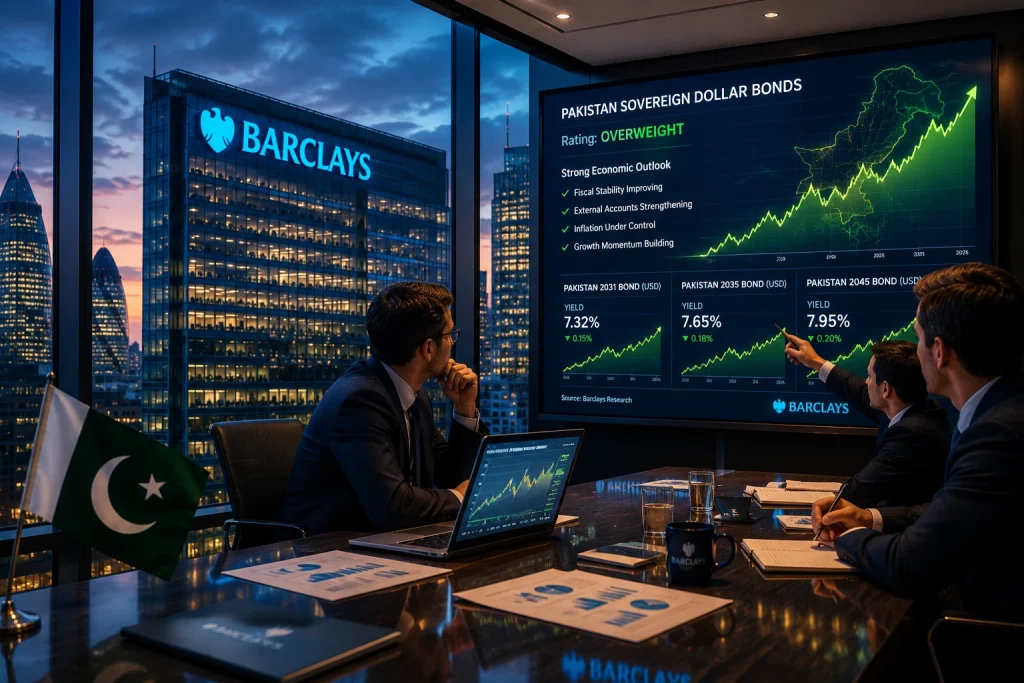
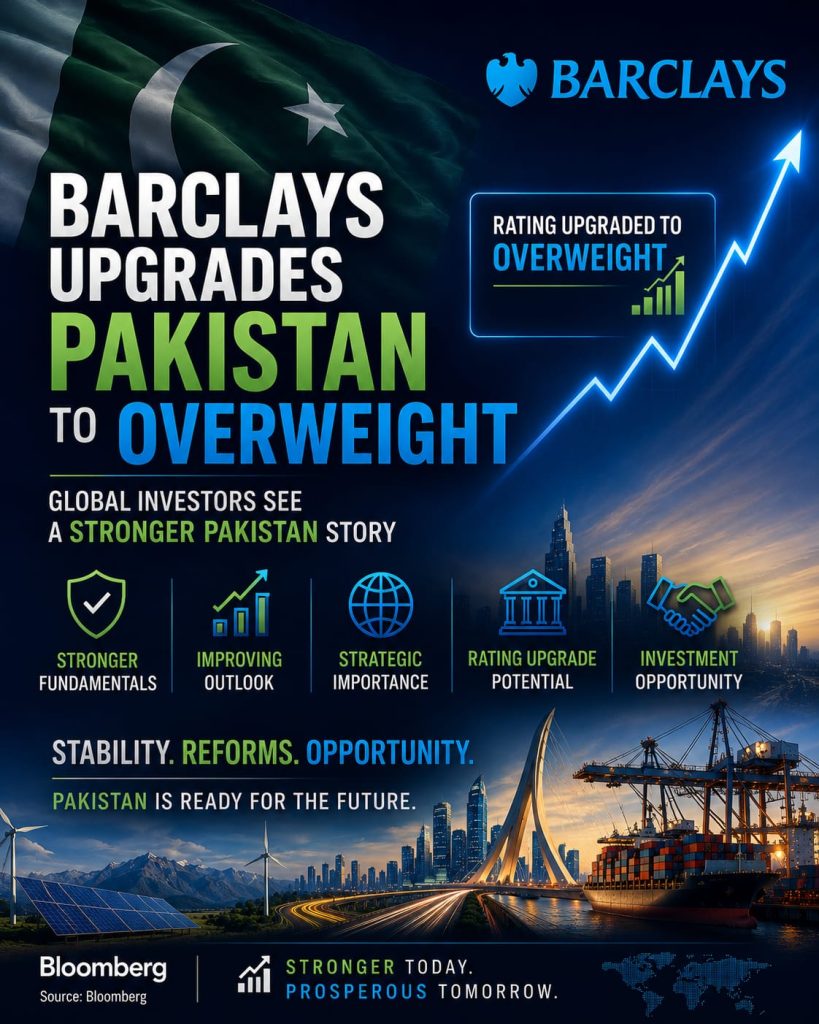
ISLAMABAD: Barclays upgraded Pakistan’s sovereign dollar bonds to Overweight from its previous stance in May, arguing that the country’s external position proved more resilient than previously anticipated. Finance Minister’s adviser Khurram Shehzad confirmed the development Wednesday, citing a Bloomberg report carrying the Barclays research note on his official X account.
Barclays Upgrades Pakistan
The bank that downgraded. Then upgraded. Within the same quarter.The research note, led by Barclays analyst Avanti Save, identified the durability of Pakistan’s external accounts as the key factor behind the revision. In capital markets, when a research desk reverses a published call that fast, institutional investors notice. It signals that something in the underlying data moved with uncommon speed and that the original pessimism had a shorter shelf life than the analysts expected.
Why Barclays Turned Bullish
The Bloomberg report quoted analysts including Avanti Save as saying the economy continued to demonstrate stability, noting an improved fiscal position, steadier external buffers, relatively steady foreign reserves, and a moderate growth and inflation picture. That is not the language of a country still lurching through a balance-of-payments crisis. That is the language applied to economies that have turned a structural corner.
Pakistan Bonds Gain Support
The specific investment recommendation that accompanied the upgrade adds further conviction to the call. Barclays recommended buying Pakistan’s 2031, 2036, and 2051 sovereign dollar bonds, along with the 2031 bond issued by WAPDA, while advising investors to sell the five-year Pakistan credit default swap. Selling CDS protection means Barclays believes the market currently overprices Pakistan’s default risk. That is a direct, monetisable expression of confidence not a public relations statement.
Also Read: Pakistan Panda Bond Could Unlock $1 Billion From Chinese Investors
The geopolitical angle sharpened the thesis further. Barclays described multilateral and bilateral financing backstops as intact, adding that Pakistan’s geopolitical position remains critical to Central Asia and the Middle East — calling it a potential tailwind. Pakistan sits at the intersection of two of the world’s most strategically contested regions. Global capital, increasingly sensitive to supply chain geography and energy corridor positioning, treats that location as an asset rather than a liability.
The timing of the upgrade carries additional weight. Pakistan navigated a particularly turbulent external environment through the first half of 2026 elevated global commodity prices, a regional conflict driving up oil market volatility, and sustained pressure on emerging market currencies. Most of its peer group buckled. Pakistan’s external accounts did not.
Sources confirmed to Focus Pakistan that the Barclays note specifically flagged oil market dynamics as a trigger for the revised view. Softer crude prices reduce Pakistan’s import bill, compress the current account deficit, and ease pressure on foreign exchange reserves simultaneously. For a country that imports virtually all of its crude oil requirements, a sustained decline in oil prices operates like a quiet fiscal stimulus one that arrives without requiring a single parliamentary vote or IMF condition.
What Comes Next
Formal credit rating agencies move on a different cadence than investment banks. Barclays itself acknowledged that credit rating upgrades have taken longer to materialise but expects agencies to review and potentially conclude positively on Pakistan’s ratings in the second half of 2026. S&P already moved first among the major agencies, upgrading Pakistan to B- from CCC+ last year. Moody’s and Fitch have not yet followed. If Barclays’ read on the trajectory holds, that gap closes before the year ends.
For Pakistan’s government, the upgrade arrives at a moment of deliberate narrative construction. The IMF’s third EFF review concluded successfully in May, unlocking approximately $1.3 billion in fresh disbursements. Gross foreign exchange reserves crossed $22.6 billion in the same month nearly two and a half times the level recorded at end-FY24. The debt management programme retired over Rs. 3.6 trillion ahead of schedule, stretching average domestic debt maturity from 2.7 years to over four years in a single fiscal year.
Each of those numbers, individually, represents progress. Together, they build the case that Barclays just validated in print.
The caveat, as always with Pakistan, runs alongside the optimism. Structural vulnerabilities a narrow tax base, energy sector circular debt, chronically low investment-to-GDP ratios remain unresolved. The Barclays upgrade reflects where Pakistan stands today, not where it needs to reach to sustain the trajectory. The distance between those two points still demands the kind of reform discipline that has historically proven difficult to maintain beyond the duration of an IMF programme.
But on Wednesday in London, one of the world’s most closely watched fixed income research desks told institutional investors managing hundreds of billions of dollars: buy Pakistan. That sentence, two years ago, would have seemed improbable. Today, it is the published, on-record position of Barclays Bank.