
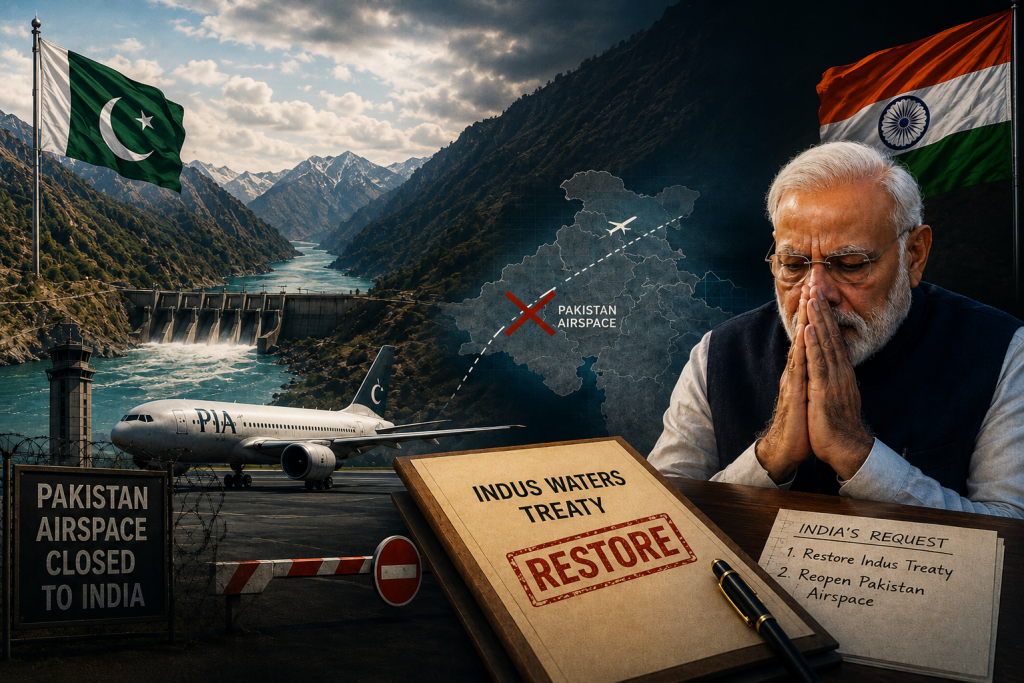
ISLAMABAD: India suspended the Indus Waters Treaty in April 2025 with the swagger of a country that believed it held all the cards. Fourteen months later, New Delhi quietly sends a message to Islamabad: it wants the rivers back on terms Pakistan sets, and in return it offers something that reveals exactly how much pain Pakistan’s countermoves have inflicted access to Pakistani skies.
India showed its readiness to revert to natural flows in the rivers and revive the Indus Waters Treaty, subject to Pakistan opening its skies to flights from India. The offer reveals the entire trajectory of a conflict started, aggravated, and that India now has to get out of.
The Weapon India Forgot Pakistan Had
Pakistan closed its airspace to all Indian carriers on April 24, 2025, in direct response to India’s decision to hold the Indus Waters Treaty in abeyance a move Islamabad characterised as an act of war. What followed delivered a masterclass in asymmetric economic leverage.
Also Read: Pakistan Signals Permanent Airspace Ban For Indian Airlines
Industry reports submitted to India’s Ministry of Civil Aviation estimated the consolidated annual loss to Indian airlines at Rs7,000 crore approximately $800 million with Air India alone facing Rs5,000 crore in projected losses and IndiGo absorbing Rs1,300 crore. Air India’s chief executive put the airline’s personal haemorrhage at Rs4,000 crore annualised. IndiGo’s flights to Central Asian destinations including Tashkent added three or more hours to journey times. Air India’s North American routes diverted through Vienna and Copenhagen for emergency refuelling flights arriving nearly six hours late.
The closure disrupted over 1,200 monthly flights to Europe and North America, adding up to 1.5 hours per transatlantic sector and Rs29 lakh in extra costs per North American flight alone.
Pakistan extended the ban repeatedly. The current notification keeps Indian aircraft locked out through July 2026, fourteen consecutive months of bleeding.
The Treaty India Said Would Never Return
India’s Home Minister Amit Shah told The Times of India with characteristic bluntness: “No, it will never be restored. International treaties can’t be annulled unilaterally but we had the right to put it in abeyance, which we have done.”
In June 2026, External Affairs Minister S. Jaishankar said the treaty would stay suspended “until Pakistan completely stops cross-border terrorism.” India’s water resources minister CR Patil confirmed the treaty remained in abeyance the same month.
The secret signal being sent to Islamabad through the back channel is entirely different. In 2025, Pakistan wrote two letters to India about flow disturbances in the Chenab River, which nourishes millions of Pakistani farmers. Manipulating the flow in the Chenab is exactly what Pakistan complained to the UN Security Council about in April 2026 when Pakistan warned the UN of the “grave peace, security and humanitarian implications” for 240 million people relying on the Indus Basin.
300 Million People, Two Nuclear States, One Negotiating Table
The basin area of Indus River is home to over 300 million individuals in both the countries, and provides agricultural fields, energy production and livelihoods for its people. Eighty percent of Pakistanis live in the Indus Basin and for them the treaty represents something more real and their right to water.
India controls the upper riparian geography. Pakistan holds the airspace geometry. Both discovered in fourteen months what sixty years of relative peace obscured: that in the 21st century, leverage runs through skies and rivers as readily as through missile trajectories.
The proposed trade, rivers for airspace forces India to acknowledge that its unilateral treaty suspension achieved nothing except a $800 million annual levy on its own aviation sector, an Air India in financial crisis, and a Pakistan that refused to blink.
Sources told Focus Pakistan the ball now sits firmly in New Delhi’s court. Islamabad has its answer ready and it comes with conditions attached.