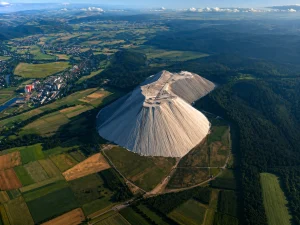


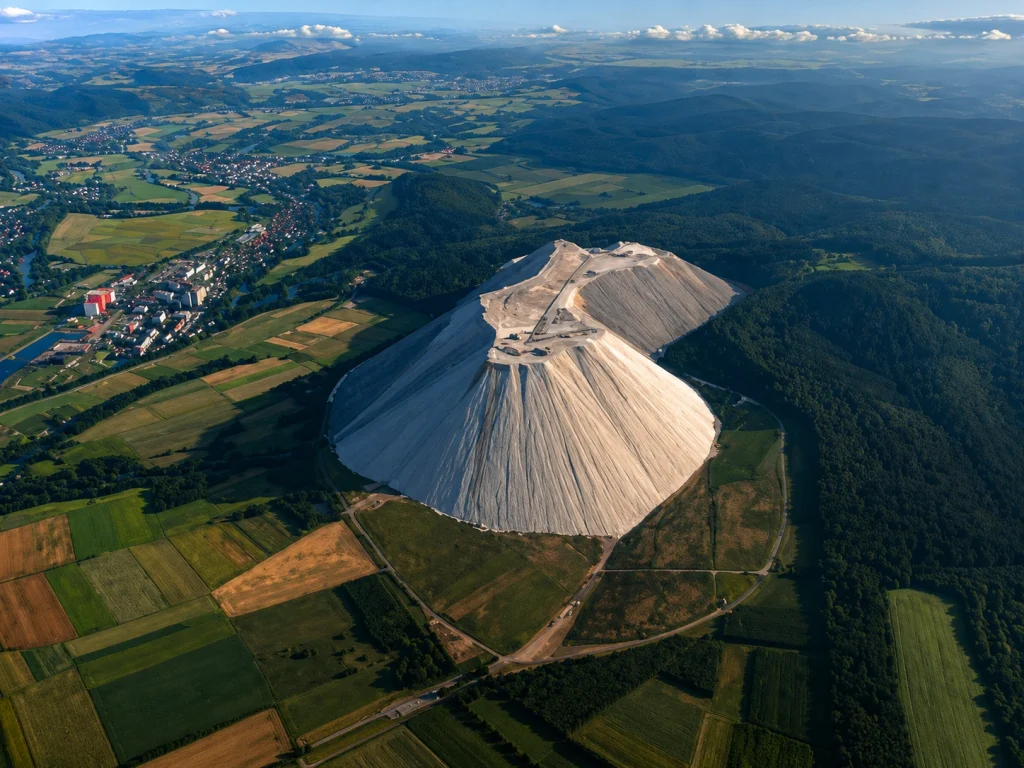
This mountain was not shaped by nature. It was formed by decades of mining debris. This is the bizarre tale behind the creation of one of Europe’s most bizarre landmarks by a German potash mine.
Generally, mountain formation is done within millions of years by tectonic forces or erosion. In case of Monte Kali, however, this process lasted for several decades and only due to one problem associated with industry and industrial waste. Located in the town of Heringen, Hesse, Germany, Monte Kali rises higher than 250 meters above the ground, with its top located at about 520 to 530 meters above sea level. It consists exclusively of salt – sodium chloride.
A Byproduct’s Evolution Into a Mountain
This tale has its roots in the production of potash – an essential ingredient for fertilizer, soap and glass, which is extracted from the mines by the potash industry in the region of Germany for more than a century. However, this process leaves a great amount of sodium chloride waste of five times the volume of the potash produced. It is dumped in Heringen site by the K+S chemical company since 1976. There was no other place where to dispose of it.
Numbers Are Boggling
Over the past four decades, since 1976, over 200 million tonnes of salt have found their way to Monte Kali; this is corroborated by the Werra Potash Mining Museum, which records the numbers at about 201 million tonnes in 2016 – an amount that has increased greatly since then. Over 900 tonnes of salt are dumped each hour, totaling around 7.2 million tonnes per year, via a 1.5 km-long conveyor belt.
The Origin of “Kalimanjaro”
The heap was given the nickname “Kalimanjaro.” The word consists of two words, namely “Kali,” which is short form for Kalisalz, meaning potash in German, and “Mount Kilimanjaro,” which is a volcanic mountain found in Africa.
From a Dump to a Tourist Destination
In spite of its humble origin, Monte Kali has managed to create for itself a reputation as a landmark that can be seen from a long distance away. Tourists have the chance of making their way to the top of Monte Kali in a matter of just 15 minutes.
ALSO READ: China Overtakes US to Claim World’s Most Powerful Supercomputer
The Environmental Price Behind the Novelty of
The uniqueness of Monte Kali hides an important environmental issue. There is more salt present in the water of the Werra River and the local ground water due to brine discharge. Of the total number of 60 to 100 invertebrates that used to live there, only a few can be found now.
This can be attributed to financial gain since the mine employs several thousand people. The company K+S reportedly obtained the license to operate up until 2060 and in 2020 was granted permission to extend the mine by 25 hectares. It’s clear that the mountain is not done growing yet.
With every passing hour, an additional 900 tons are being added to something that weighs more than 200 million tons – a creation of mankind’s industry, climbable by visitors and one that is accountable for causing damage to ecology. There is little chance that Monte Kali is going to stop expanding anytime soon.

Nayab Fatima is a university graduate and an emerging media professional with a strong passion for journalism, research, and independent reporting. She specializes in developing well-researched, fact-based, and analytical news stories covering a wide range of sectors, with particular expertise in technology, telecommunications, aviation, and the automobile industry.