
Pakistan Joins WAICO as Founding Member of New Global AI Body
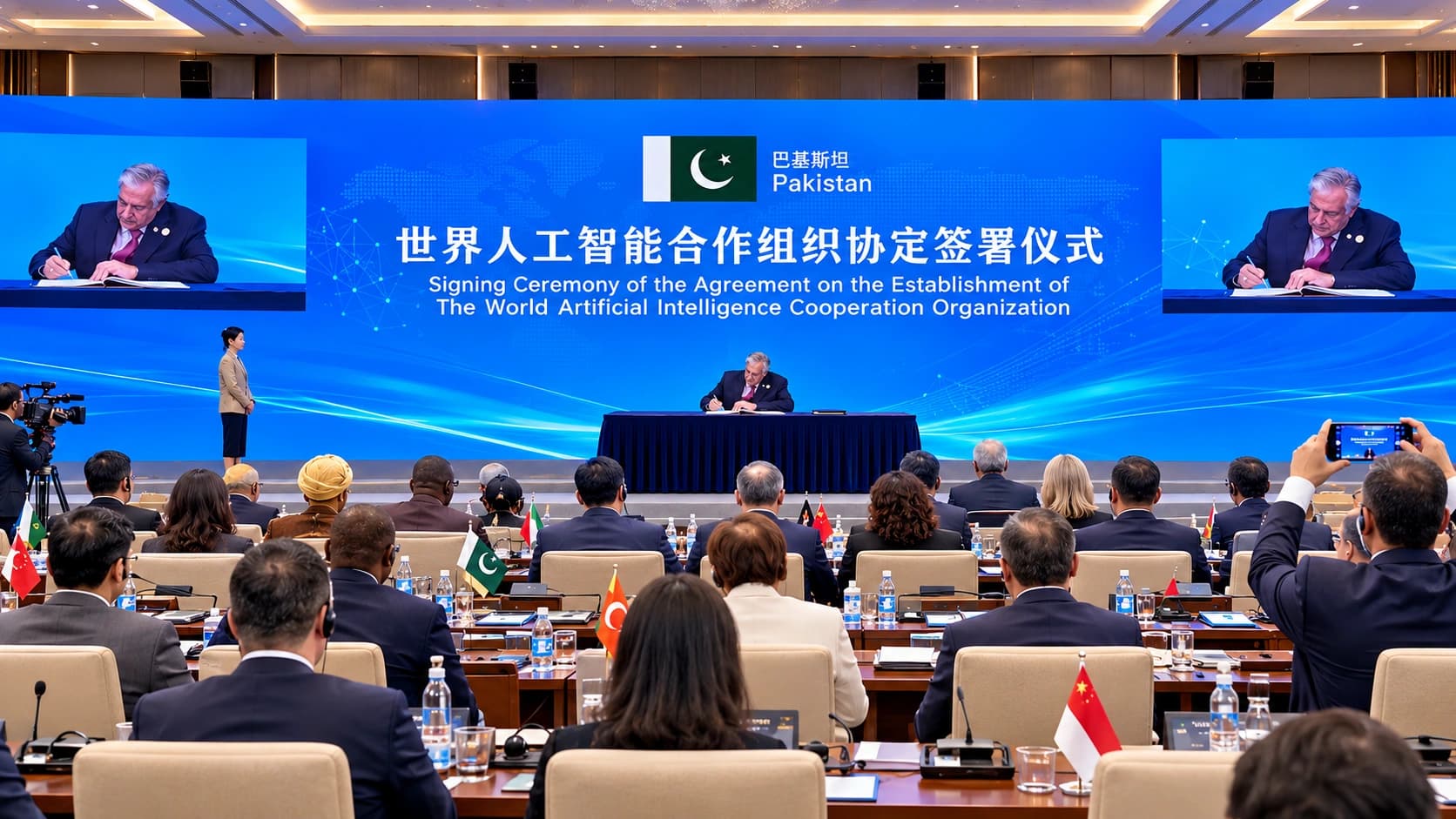
BEIJING: Pakistan just picked a side in the world's biggest tech rivalry, and it wasn't Washington's. Deputy Prime Minister and Foreign Minister Ishaq Dar signed Pakistan into the founding charter of the World Artificial Intelligence Cooperation Organization on Thursday in Shanghai, joining 28 other countries at a ceremony that pointedly excluded every major Western power. Russia, Indonesia, Kazakhstan, Laos, Brazil, Belarus, Serbia, Cuba and Venezuela signed alongside Pakistan, according to Chinese state media. Asia supplied 12 of the signatories and Africa contributed 10, leaving the roster almost entirely outside traditional Western alliances.
China’s foreign minister, Wang Yi, signed on behalf of China, while the UN Secretary-General, Antonio Guterres, was present for the signing ceremony, an aspect that China will definitely bank on as evidence that the new body will have international legitimacy despite America’s and Europe’s lack of interest in it. Indeed, this is an important move by China to ensure that it institutionalizes its influence in the way the global digital economy and technology is regulated, considering that China and America are currently competing on the regulation of AI.
Pakistan Joins WAICO
WAICO will run out of Shanghai as an independent intergovernmental body built around three goals: promoting international cooperation, shaping global AI governance, and steering development that member states consider safe, fair and beneficial. Pakistan's foreign ministry framed its membership around a different priority using the seat to push AI cooperation from a Global South perspective and to narrow the gap between countries that already have advanced AI infrastructure and those that don't.
What WAICO Will Do
The director of the center for Artificial Intelligence at NUST, Yasar Ayaz, referred to it as a step up in collaboration between Pakistan and China in the realm of artificial intelligence. This collaboration has been progressing consistently for the past year now.
Pakistan adopted a National Artificial Intelligence Policy in 2025, recognized AI as a national priority and promised in February to invest one billion dollars by 2030 in the development of sovereign computing infrastructure, research capability and training. This year, Islamabad also got involved in another AI project backed by China with the purpose of boosting national sovereignty in regard to AI systems, data, and computing infrastructure and decreasing dependency on foreign platforms.
Pakistan laid the groundwork for Thursday's signing in May, when Prime Minister Shehbaz Sharif visited China and formally endorsed Beijing's proposal to establish WAICO.
China's AI Push
The timing carries its own signal. China first proposed WAICO at last year's AI conference, but no country formally joined until this week's signing, which took place on the eve of the 2026 World AI Conference in Shanghai. Major US tech firms are largely absent from that conference, underscoring how cleanly the new organization splits along geopolitical lines. Analysts increasingly describe WAICO as a governance framework built specifically for countries that sit outside Western regulatory regimes like the EU's AI Act.
For Pakistan, founding membership offers a formal seat at a table Beijing is actively building one that positions the country inside China's technology orbit just as the US-China contest over AI's future rules intensifies.


Leave a Reply
Your email address will not be published. Required fields are marked *