
Punjab Announces 130-Acre SME Industrial Estate at Kot Pindi Das
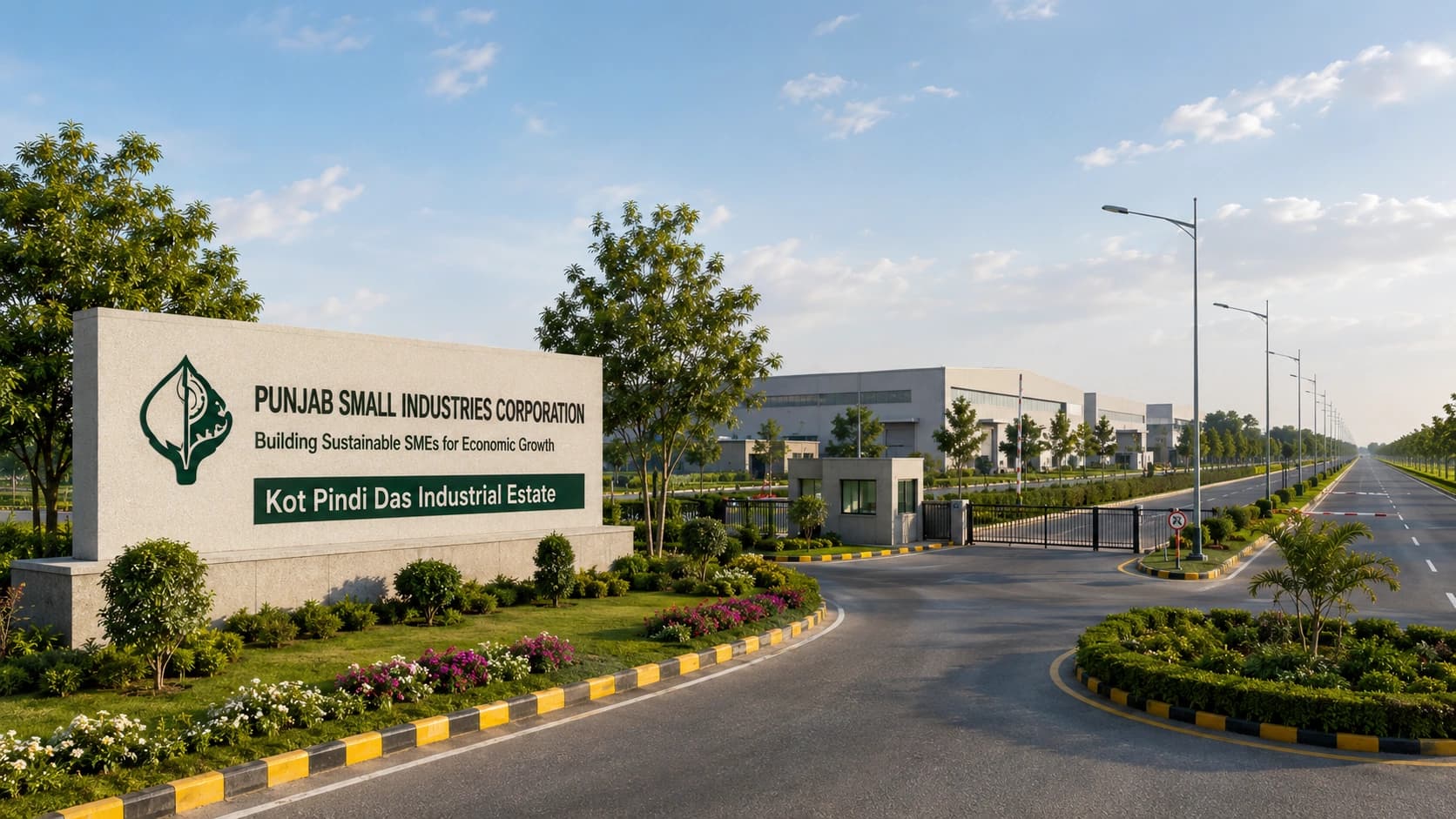
LAHORE: A new industrial area is being established by Punjab Small Industries Corporation (PSIC) in 130 acres in Kot Pindi Das, Lahore, stated Managing Director Mubeen Elahi on Thursday as chamber representatives urged the government to stop its enforcement action against factories to be evicted from existing industrial areas.
Elahi presented his idea during the discussion that took place between him and a delegation from LCCI headed by its president Faheem Ur Rehman Saigol in PSIC office. This venture will provide 364 industrial plots which will be awarded to those who will participate in balloting after development process is completed.
Pricing Policy
Under the pricing policy, entrepreneurs must pay 40 percent as a down payment and can pay the remaining 60 percent in three quarterly installments over two years. Elahi said PSIC has fixed the land price at Rs5 million per kanal, including all development charges.
Saigol used the meeting to push PSIC toward faster execution, not just around Kot Pindi Das but across Lahore's industrial planning more broadly. He argued that businesses cannot relocate out of older zones until the government builds fully serviced alternatives and he tied that demand directly to enforcement actions already underway.
Government agencies have sealed units and issued relocation notices to factories in Saggian, Daroghawala and Multan Road in recent weeks, according to Saigol, who said these industries have operated in place for decades, generating jobs, paying taxes and contributing to national export volumes. He said owners built factories in these locations in the first place because the government never offered planned, affordable industrial estates as an alternative and he insisted authorities cannot now penalize businesses for a gap in planning that predates them.
Also Read: Maryam Nawaz Unveils Punjab’s Biggest-Ever 50,000 Tractor Programme
Lahore's existing industrial estates have little room left to absorb displaced units, Saigol said, either running at full capacity or approaching it. He called on PSIC to lead the development of new SME-focused estates equipped with electricity, gas, water, roads, sewerage and drainage from day one, alongside plug-and-play facilities and single-window registration to get factories producing quickly.
Kot Pindi Das Industrial Estate Relocation Challenge
He requested the government to stay its enforcement notice by the Ravi Urban Development Authority (RUDA), Environmental Protection Agency, and Lahore Development Authority until relocation is possible for them. According to Saigol, the industry understands the importance of compliance with environmental standards and planning but requires proper time as well as proper infrastructure for the process.
Another gap appeared in the discussion made by Saigol that the government is lacking data about the actual location of industrial clusters in Lahore city. He asked PSIC to draft a long-term master plan for SME estates in consultation with LCCI to close that information gap.
PSIC Kot Pindi Das Payment Plan
LCCI Senior Vice President Tanveer Ahmed Sheikh welcomed the Kot Pindi Das project but pushed PSIC to expand its financing beyond land purchases. He argued that funding should also cover construction of factory buildings and the purchase of plant and machinery, since the relocation burden extends well past acquiring a plot. The Sheikh observed that industries were operating under high production costs and decreasing rate of employment generation and suggested PSIC introduce the estate on a small-scale basis initially before scaling up depending on real demand.
The executive committee members made other suggestions at the meeting, among which included phased relocation according to particular industrial clusters, incentives for relocating firms, estate expansion to at least 500 acres, and leasing of the land for 20 years through public private partnerships.
Kot Pindi Das now becomes a test case for whether Punjab can convert planning documents into operational estates fast enough to keep pace with an enforcement drive that is already displacing factories. The chamber's message on Thursday was less about opposing relocation than about sequencing — build first, then enforce.





Leave a Reply
Your email address will not be published. Required fields are marked *