
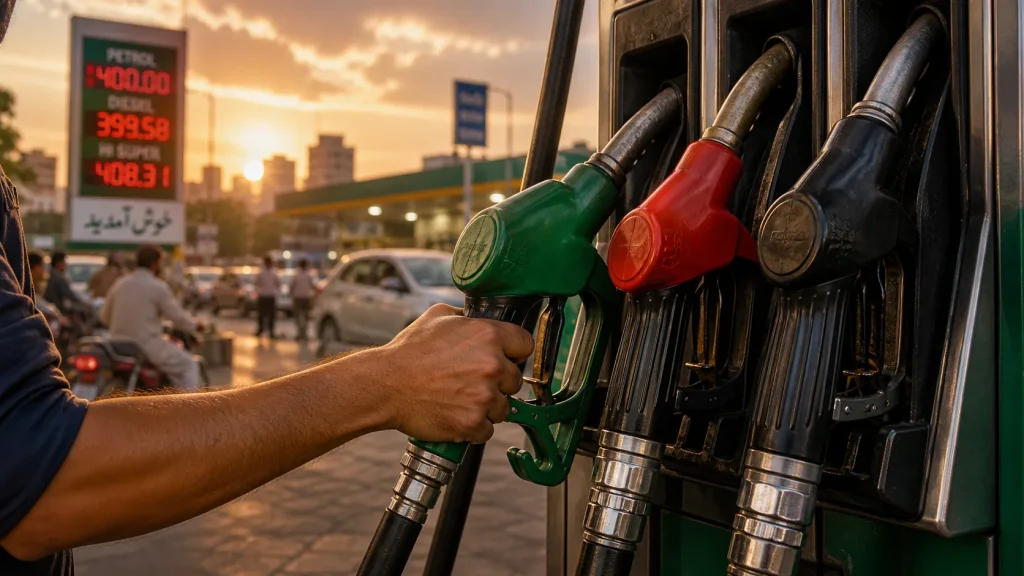
Petrol price breakdown Pakistan reveals that consumers pay Rs153 in taxes on every litre, pushing the final price close to Rs400 despite a much lower base cost.
ISLAMABAD: The government’s break-up of petrol prices in Pakistan, taxes, surcharges, and margins take away 38 percent from every liter of petrol and 29 percent from every liter of high-speed diesel which is all borne by ordinary people.
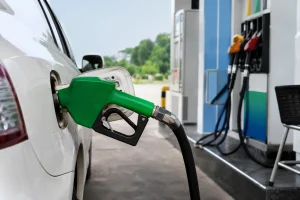
In every Pakistani person’s filling of a car or motorcycle at the pump, more than a third goes into the government coffers and not into the refineries, into imports, or even into the fuel. This fact has been formally accepted by the government authorities this week itself, as the government stated that it collects a tax and levy of Rs 153.55 for every liter of petrol, and Rs 116.46 for every liter of high-speed diesel.
Also Read: Pakistan Petrol Prices Set to Drop as PM Shehbaz Orders Full Benefit Transfer to Public
The price of petrol at the ex-refinery level, that is, the actual price of the fuel without any interference from the government, stands at Rs 246.31 per liter. After the inclusion of custom duty, logistics charges, marketing expenses, dealer’s commission, cess on petroleum education, and climate change, the cost comes to Rs 399.86 per liter. The margin between the two prices of Rs 153.55 is the government’s profit margin. On the other hand, the price of high-speed diesel at the ex-refinery level is Rs 283.12 per liter, whereas the total cost after all the deductions comes to Rs 399.58, which makes a difference of Rs 116.46.
Petrol Price Breakdown Pakistan and the Rs400 Reality
The single biggest weapon in the government’s pricing arsenal is the petroleum levy — a charge that now stands at Rs 103.50 per litre on petrol after the Petroleum Division trimmed it by Rs 3.88 in its May 1 notification. That reduction sounds generous until you realize the same notification simultaneously imposed a fresh Rs 28.69 per litre levy on high-speed diesel — a fuel that previously carried zero petroleum levy. Transporters, farmers running tube-wells, and the entire goods-movement economy now absorb that new cost every day.
The combined tax liability for consumers is still high at around Rs 120 per liter on petrol and Rs 60 per liter on diesel. In light of this information, revenue generation from the taxation of fuel can go up to Rs 180 billion in one month alone.” Miftah Ismail, Former Minister of Finance, X post, May 1, 2026.
Why The Govt Leans so Hard on Fuel Taxes
Pakistan’s fuel levy structure does not exist by accident. Revenues from the total petroleum levy have already topped Rs 1.2 trillion in the first nine months of the current fiscal year, which constitutes about 82% of the Rs 1.468 trillion annual target for such revenues. The authorities prefer petroleum levies just because it is impossible to evade the levy. The Petroleum Division acknowledged that petroleum levies generate guaranteed revenue because authorities collect them directly at the fuel pricing stage, making them easier to recover than conventional taxes that depend on compliance and enforcement.
Pakistan’s commitment to the International Monetary Fund also tightens this vice. This increase in fuel taxes by the government is indicative of their desperate need for income generation during the last few months of their fiscal year. The government is struggling to make ends meet and stabilize the country’s economic situation under such trying circumstances, but the failure of the FBR in meeting its income targets means that the petroleum tax makes up for this shortfall, and Pakistanis pay for it every single day.
What This Means for Inflation and Ordinary Life
Fuel at Rs 400 per litre does not hurt only at the petrol pump. It travels instantly into transport fares, food prices, electricity tariffs, and manufacturing costs. The concurrent rise in the cost of fuel and the imposition of taxes is inflationary in nature, which means higher costs for transportation and possibly an increase in the price of basic necessities across the country. In a country where a large portion of the populace spends more than half of its income on food and travel, a tax burden of Rs 153 per liter on petrol is more than just another fiscal measure; it is the reality that hits thousands of families each month.
Until the country undergoes a transformation of its tax system, expanding its revenue base from only those who buy fuel, the calculations will be repeated each time a new price notification comes from OGRA.

Focus Pakistan is an independent digital news and media platform dedicated to delivering credible, insightful, and impactful journalism across Pakistan and beyond. The publication covers a broad range of sectors including business, economy, technology, telecommunications, aviation, automotive, infrastructure, energy, tourism, public policy, and national affairs.
Committed to accuracy, transparency, and editorial integrity, Focus Pakistan combines breaking news coverage with in-depth analysis, feature stories, expert commentary, and research-based reporting. The platform aims to provide readers with timely, factual, and balanced information while promoting informed public discourse and responsible journalism.
Through its commitment to high editorial standards, Focus Pakistan strives to be a trusted source of news and analysis for policymakers, business leaders, industry professionals, and the general public.