
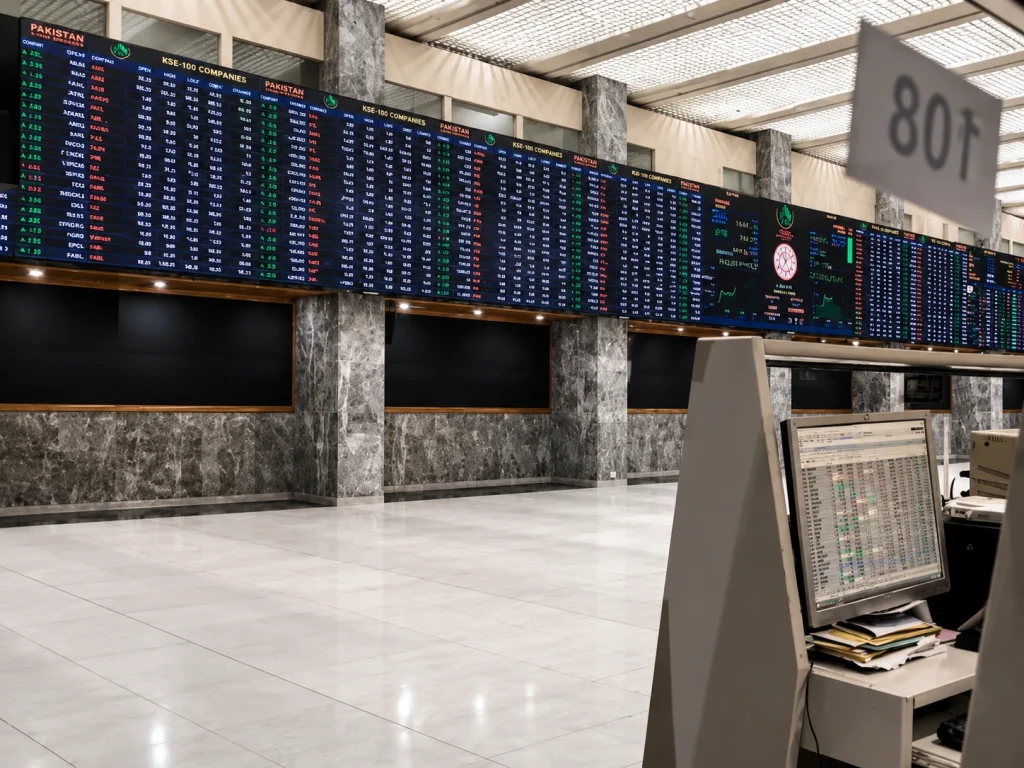
ISLAMABAD: New tensions between the US and Iran have brought fresh selling into the Pakistan Stock Exchange, where the KSE-100 index fell by 1,615.58 points or 0.93%. This decline was seen by 9:40 am when the KSE-100 reached 171,278.69, erasing most of its gains seen during earlier sessions that week.
The KSE-100 drops on Friday came after the gain of 1,189.52 points seen on Thursday, where the index closed at 172,894.28 – showing how steep the turnaround was. In addition, the loss seen on Friday wiped away all the gains made during a whole trading day in just an hour’s time on Friday morning.
Selling is affecting seven different industries with heavy weight stocks falling in the red
The fall in the KSE-100 index on Friday was the result of widespread selling activities that impacted seven key sectors: automobile assembly, cement, commercial banking, fertilizer, exploration and production of oil and gas, oil marketing, and power generation. This indicates that investors had diversified their holdings by exiting the entire market.
The heavy-weight stocks suffered most of the pressure. Three out of the four biggest explorers of oil and gas in the country, MARI, OGDC, and PPL, were trading in the red zone, indicating investor fears over the impact of escalating hostilities between Arab countries on Pakistan’s oil and gas industry. Besides, other heavy-weight stocks like PPL, POL, FFC, MCB, MEBL, and UBL were trading in the red, eroding billions of rupees off the market capitalization of the KSE-100 Index in the first hour of Friday’s trade.
Firing from US and Iran prompts investor concern amid ceasefire talk
In terms of geopolitics, the reason for the fall in KSE-100 was the actual firing exchange between US and Iran forces, which alarmed investors worldwide and made them shift towards risk-off mode. Although there was an actual exchange of firing between the two nations, neither side seemed interested in further intensification of the conflict.
With the actual use of force combined with diplomatic hints about non-progression, this has created a situation of uncertainty that the market finds very hard to price – since it is not possible for investors to factor out completely any possibility of conflict once there has been actual exchange of fire, despite any reassurances by the leadership regarding restraint.
ALSO READ: PSX Jumps 1,498 Points on Iran–US Talks Optimism, Investors Cheer Relief Rally
Brent crude jumps by 1.3% to hit $101.60 amid risk in the Middle East
The international oil markets have shown a far stronger reaction to the US-Iranian crisis than the equity markets. Brent crude has jumped by 1.3% to hit $101.60 per barrel, an occurrence that has immediate ramifications for Pakistan’s import bill, the country’s current account, and the cost structure of the energy and transport industries that form a significant part of the KSE-100 Index.
Rising prices of crude oil impose a two-pronged impact on the Pakistani stock market, by raising costs for businesses importing energy and by exerting pressure on the overall macroeconomic context due to a larger trade imbalance and higher expectations of inflation. The decline in the KSE-100 on Friday is partly explained by this double effect of rising oil prices.
Trends vary in Asian markets amid decline in global stocks sentiment
The KSE-100 index of Pakistan fell in tandem with other Asian equities markets which have been seeing a general downtrend amid weakening sentiment for global equities markets today. The MSCI Asia ex-Japan Index was down 0.8% amid the same geopolitical risk aversion that pushed stocks to sell off at the Karachi stock exchange. The KOSPI index of South Korea fell today but showed strong gains during the week as compared to Taiwanese and Japanese markets that had seen robust gains for the week amid technology stocks’ performance.
The weekly context is important in the interpretation of the drop in the KSE-100 on Friday. Although there was a loss of 1,615 points during the first part of trading on Friday, the index opened the session at 172,894 points, which indicated the previous gains made due to the optimism of the investors regarding the resolution of the energy crisis worldwide. The situation on Friday shows that geopolitical risks can quickly become dominant despite positive fundamentals in the country.

Focus Pakistan is an independent digital news and media platform dedicated to delivering credible, insightful, and impactful journalism across Pakistan and beyond. The publication covers a broad range of sectors including business, economy, technology, telecommunications, aviation, automotive, infrastructure, energy, tourism, public policy, and national affairs.
Committed to accuracy, transparency, and editorial integrity, Focus Pakistan combines breaking news coverage with in-depth analysis, feature stories, expert commentary, and research-based reporting. The platform aims to provide readers with timely, factual, and balanced information while promoting informed public discourse and responsible journalism.
Through its commitment to high editorial standards, Focus Pakistan strives to be a trusted source of news and analysis for policymakers, business leaders, industry professionals, and the general public.