



KARACHI: After a 12-year delay, Pakistan Petroleum Limited (PPL) finally commissions the Faiz X-1 Deep well. Read how a decade of stagnation cost Pakistan’s energy sector. Pakistan Petroleum Limited (PPL) has finally ended a staggering twelve-year period of stagnation
On Friday, the petroleum giant made an announcement regarding the commissioning of the Faiz X-1 Deep (Basal Sand) well. The achievement is being referred to as a “milestone” by the company; however, its timing brings into question why such a crucial energy source was allowed to remain inactive for over ten years.
The Cost of a Decade-Long Delay
Located in the Sanghar district of Sindh, the Faiz X-1 Deep well belongs to the Gambat South Block. PPL originally drilled the well in 2014. However, for more than ten years, the company failed to bring the resource online. In an official notice to the Pakistan Stock Exchange (PSX), PPL admitted that the project remained “uneconomical” for years due to a total lack of nearby pipeline infrastructure.
This delay highlights a recurring nightmare for Pakistan’s energy sector: significant discoveries left in the ground because of logistical failures. While the country struggled with gas shortages and high import costs, this domestic asset gathered dust.
Also Read: Delay in LNG Supply May Trigger Higher Electricity Prices and Increased Load Shedding
Turning the Tide: Technical Execution
In spite of previous setbacks, PPL expedited the process of integrating the well into the national power grid. The well was finally inaugurated on February 25, 2026, by the company. This was made possible by carrying out several complex interventions.
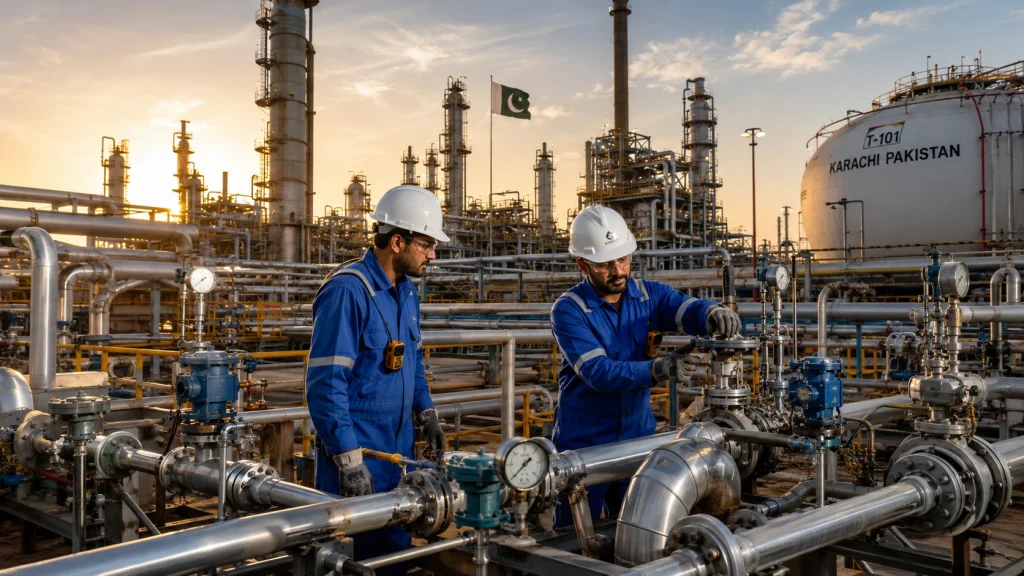
According to the PSX filing, PPL’s engineers isolated deeper intervals and performed complex well intervention jobs. To connect the well to the existing network, the company constructed approximately 4.5 kilometers of feeder line. This infrastructure now links the well directly to the Gambat South Gas Processing Facilities.
Current Production and Economic Impact
The output by PPL has been gradually increased in order to maintain operations smoothly. The Faiz X-1 Deep well is producing around 3.6 MMscfd of natural gas. In addition to this, the well is yielding 750 bpd of condensate.
The company finally greenlit the project after a comprehensive technical and economic re-evaluation. By establishing connectivity with other existing pipelines, PPL’s management determined that the Basal Sand interval was finally commercially viable.
PPL’s Role in a Fragile Market
As one of Pakistan’s largest exploration and production (E&P) firms, PPL carries the heavy burden of securing the nation’s energy future. While the successful commissioning of the Faiz X-1 well provides a much-needed boost to domestic supply, the decade of inactivity serves as a grim reminder of the inefficiencies plaguing the industry.
For investors and energy analysts, the move to unlock “lost” wells like Faiz X-1 is a step in the right direction. However, the industry must now focus on why such discoveries take over ten years to reach the consumer. With optimization of the operating parameters by PPL, the issue becomes how well PPL is able to avoid wasting similar “decades” in the future explorations.
The commissioning process is thus a great win for the technical staff at PPL, but it also calls for immediate action towards building necessary infrastructures alongside the exploration process. Otherwise, the nation will be unable to exploit the underground wealth within the next decade.

Focus Pakistan is an independent digital news and media platform dedicated to delivering credible, insightful, and impactful journalism across Pakistan and beyond. The publication covers a broad range of sectors including business, economy, technology, telecommunications, aviation, automotive, infrastructure, energy, tourism, public policy, and national affairs.
Committed to accuracy, transparency, and editorial integrity, Focus Pakistan combines breaking news coverage with in-depth analysis, feature stories, expert commentary, and research-based reporting. The platform aims to provide readers with timely, factual, and balanced information while promoting informed public discourse and responsible journalism.
Through its commitment to high editorial standards, Focus Pakistan strives to be a trusted source of news and analysis for policymakers, business leaders, industry professionals, and the general public.