
With almost a year gone by since Musk heralded the arrival of a new age for self-driving technology, the robotaxis project for Tesla has become a massive disappointment. Only 59 robotaxis exist in three cities in Texas Austin, Dallas, and Houston. When Tesla talks about millions of cars revolutionizing everything, it’s clear they are lagging behind their own promises.
The implementation of Tesla robotaxis began in the middle of 2025, with the city of Austin becoming the main testing ground for the technology. Indeed, selecting Austin was a wise move – Texas allowed more flexible regulation of self-driving vehicles than other states, while its roads were easy to navigate for autonomous cars. Still, the expansion moved at a snail’s pace despite all favorable factors.
Musk’s Promise of Scale. Reality Was Different.
The projections from Tesla itself indicated fast growth – hundreds or thousands of cars deployed throughout major U.S. cities in mere months after launch. Elon Musk consistently emphasized this idea, positioning Tesla’s robotaxis not as just another offering but a completely new approach to urban transportation.
User feedback from some of the earliest testers of the Tesla robotaxi service tells a tale of a platform still in its infancy. Unusually long waiting periods, erratic availability of vehicles, and restricted routes within geofenced areas characterize the experiences of early adopters of this technology. This is more than mere inconvenience; rather, these issues constitute structural roadblocks to the ability to compete with other ride hailing services.
While geofencing makes sense for safety reasons, it severely limits the application of this service in its practical application. A robotaxi that does not deliver a passenger from point A to point B since one of these points lies out of an allowed operational zone cannot be considered a viable replacement.
The Environment for the Robotaxi Becomes Even More Challenging for Tesla
Meanwhile, the environment for the development of the robotaxi service from Tesla has become less favorable too. Indeed, Google’s Waymo company already operates a fleet of more cars than Tesla does in several US cities and thus remains the leader in terms of the deployment of commercially oriented driverless technology. Contrary to Tesla, Waymo prefers to use sensors rather than only cameras.
ALSO READ: Elon Musk Praises Pakistan After Lahore High Court Upholds Death Sentence in Motorway Gang Rape Case
Camera-Only Bet: Ingenious Move or Irreversible Mistake?
Elon Musk claims that since humans see with their eyes, computers must rely on vision as well. The principle is clear; implementation is still an open question.
Industry critics have argued that there are certain environmental conditions where even human eyesight struggles, like heavy rains, glare from the sun, and dark nights with insufficient artificial light. The key question now is whether or not the enhancements to Tesla’s FSD software will be sufficient to bridge this technological divide.
The Cybercab: The Next Big Bet on an Already Tense Timetable
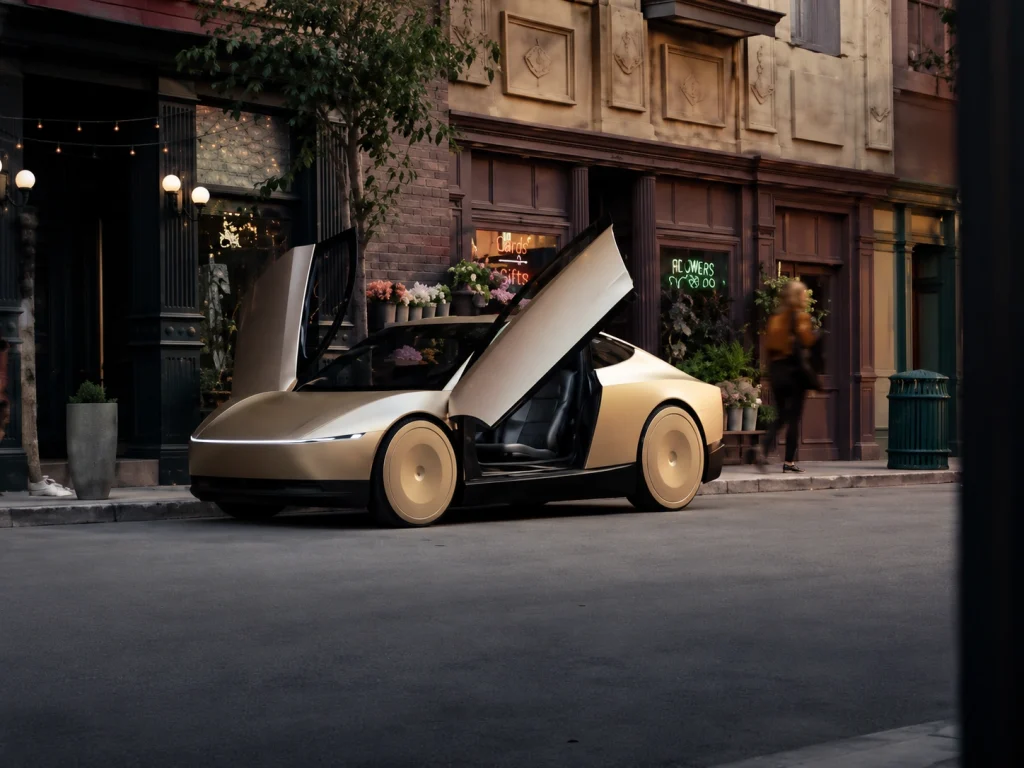
Tesla does not rest on its laurels. It has already unveiled the Cybercab a dedicated self-driving car that has been crafted specifically for robotaxis, and comes without any steering wheel or pedal controls. Manufacturing is set to commence in 2026, and the Cybercab will be the real workhorse of robotaxi fleets.
The Cybercab idea is quite bold. Using an existing car to create an autonomous one would be both expensive and difficult, but having a new purpose-built model solves that issue.
Engineering prowess, big data gleaned from millions of FSD-enabled consumer cars, and economies of scale make for a unique set of strengths that not even one other autonomous vehicle company can claim. Going from 59 to 59,000 cars is definitely achievable, at least in theory.
But while theory and practice may be worlds apart, especially when it comes to self-driving vehicles, one thing is certain: Tesla’s robotaxi concept might indeed be ahead of its time. Right now, the gap between Musk’s lofty predictions and the actual robotaxi test track in Austin speaks volumes about all the shortcomings of the company.