


Q-Autos’ Kaiyi launch fires the boldest pricing shot in Pakistan’s EV history. The real question is what happens after the first 200 bookings run out.
Pakistan’s automotive market just absorbed its most provocative entry in years. Q-Autos, a subsidiary of the Q-Links real estate group, marched into Lahore and introduced Chinese brand Kaiyi with a lineup that forces an uncomfortable conversation for Pak Suzuki, Toyota, and every other legacy automaker still selling petrol hatchbacks at prices that once seemed inevitable.
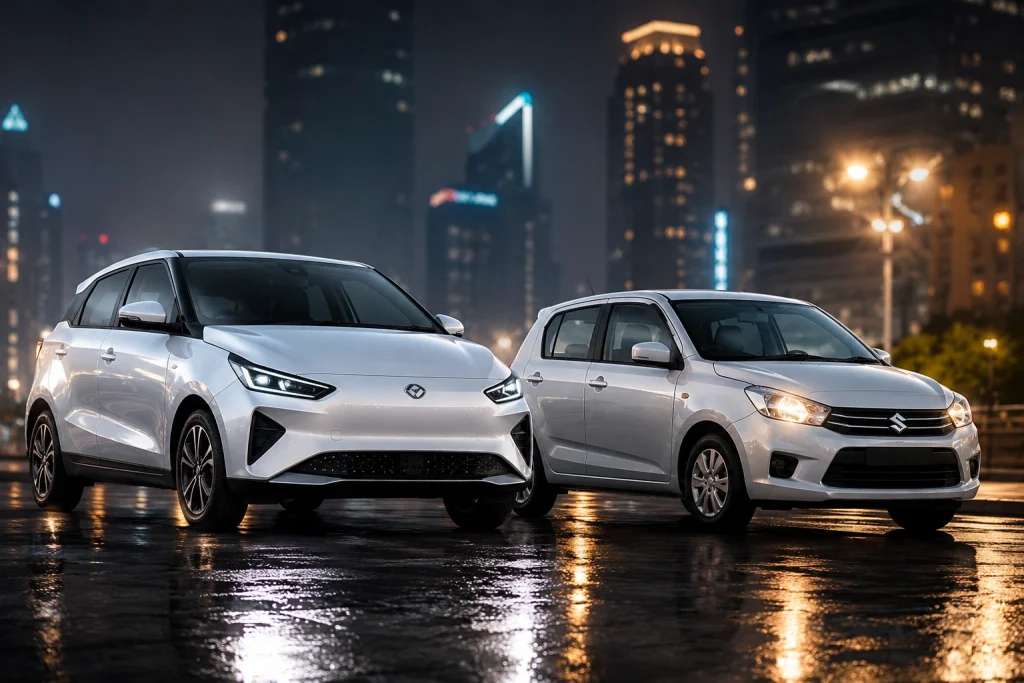
The centrepiece of that conversation: a brand-new electric hatchback, the Kaiyi e-Qute 04 carrying an introductory sticker of Rs. 3.99 million. That figure sits below the base Suzuki Cultus VXR, which Pak Suzuki currently prices at Rs. 4.089 million ex-factory. A Chinese EV, bigger than a Cultus, with a 300-kilometre claimed range and a 360-degree camera system, has arrived at a price point that the Japanese-origin hatchback cannot match.
That is not a minor data point. That is a structural challenge.
The Full Kaiyi Lineup at a Glance
Q-Autos launched three electric vehicles at the Lahore event: the X3 Pro EV crossover and two variants of the e-Qute 04 hatchback. A fourth model the Kaiyi X7 Hybrid SUV received a preview teaser, with no confirmed launch date.
The X3 Pro EV arrives as the flagship. Q-Autos brought only the top-tier variant to Pakistan, skipping the petrol-powered X3 Pro entirely. Priced at Rs. 7.49 million regular, the first 200 units carry a Rs. 6.79 million introductory rate, a discount of 700,000. The car has an impressive 53.6 kWh Lithium Iron Phosphate battery that delivers 161 horsepower power, offering a single charge mileage of 401 km, along with 18-inch alloy wheels, panoramic sky roof, 360-degree camera, 10.25 inch instrument cluster, and multi-link rear suspension.
Also Read: Has Hyundai Tucson Forced KIA Into Pakistan’s Biggest SUV Price War?
The e-Qute 04 hatchback comes in two versions. The version with a range of 300 kilometers is equipped with a 28.08 kWh battery pack; the one with a range of 400 kilometers uses a 39.26 kWh battery pack. Both are fitted for DC fast-charging technology (30%-80% charge in 30 minutes) and 360° camera system unique in its category of cars. Standard delivery for confirmed bookings falls in August 2026, with a first shipment of 31 units expected by mid-June for display and early handovers.
Price, Technology & Competition: The Full Comparison
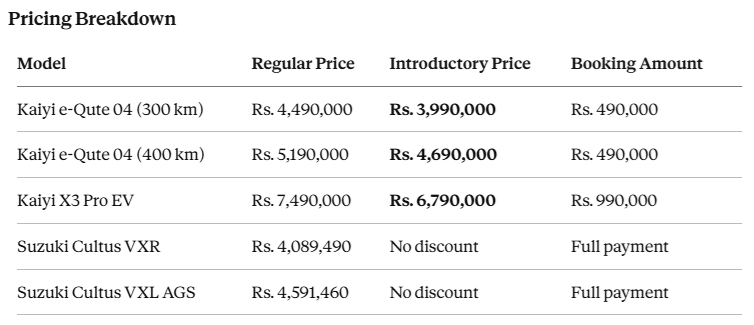
The introductory pricing window closes after the first 200 units of each model. At regular rates, the e-Qute 04 300 km variant rises to Rs. 4.49 million-Rs. 400,000 above the base Cultus, which partly deflates the headline. But for early movers, the value case is real.
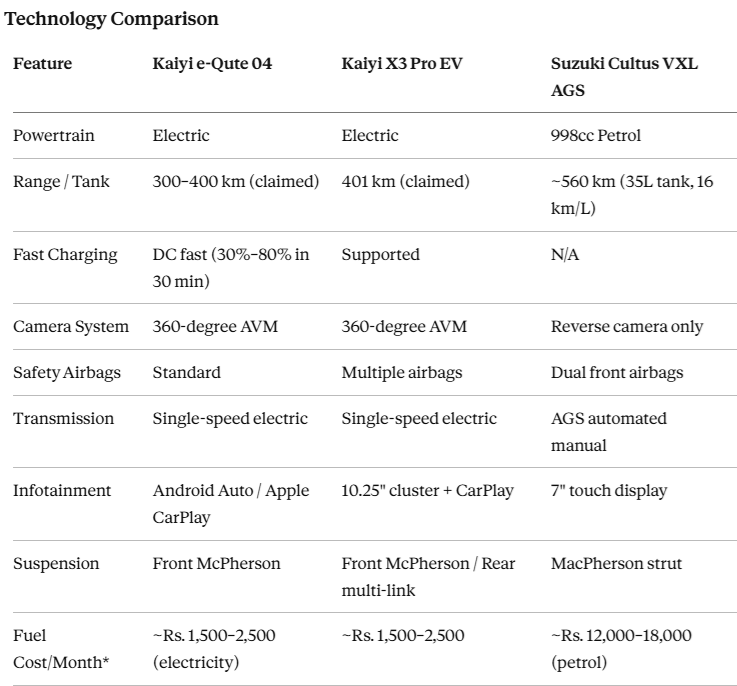
Estimated monthly running cost based on 1,500 km average city use and current energy prices.
On technology per rupee, the Kaiyi models are not close competitors to the Cultus. They operate in an entirely different league of onboard features. The question is whether Pakistani buyers trust that technology and the infrastructure behind it.
The Brand Behind the Cars
Kaiyi is not a pop-up operation. The brand clocked an export growth rate of 233.27% in 2025 — the highest among all Chinese automakers, ahead of BYD at 129.52%, Jetour at 48.10%, and Baojun at 16.71%. That is a remarkable trajectory for a brand most Pakistani buyers have never heard of, and Q-Autos leaned heavily on that data point at the Lahore event to pre-empt the obvious scepticism.
Also Read: Imported EVs Over $75,000 To Face 40% FED Under Budget 2026
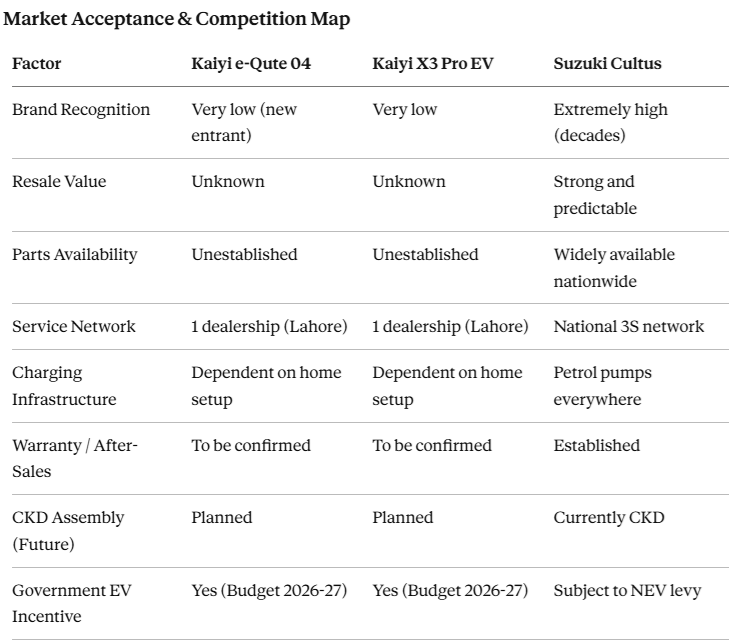
The company confirmed a local CKD assembly plant is in the pipeline, though no operational date is locked. CKD assembly would reduce import duties and vehicle costs significantly the same model that allowed Kia, Hyundai, and MG to eventually lower prices after initial CBU launches. For now, the introductory units arrive as completely built units.
Running Cost: Where the EV Math Gets Compelling
Pakistan’s petrol prices have swung between Rs. 250 and Rs. 280 per litre through 2025-26. A Suzuki Cultus covering 1,500 kilometres monthly at 16 km/L burns through roughly 94 litres a monthly fuel bill approaching Rs. 25,000 at current pump rates.
An EV covering the same distance on Pakistan’s residential electricity tariff approximately Rs. 50-60 per kWh in the average domestic slab spends somewhere between Rs. 2,000 and Rs. 3,500, depending on the battery size and charging efficiency. Over a 5-year ownership period, that gap runs into the millions. It is the single strongest argument in favour of EV adoption, and it becomes more compelling every time the government adjusts the petroleum levy upward.
Also Read: Electric Cars in Pakistan May Get Costlier as Government Weighs 25% Tax
The Kaiyi e-Qute 04’s 300 km claimed range covers the average Pakistani city commuter’s needs with room to spare. The 400 km variant opens up intercity use on shorter routes.
The Bigger Picture
Pakistan’s Budget 2026-27 introduced a tiered FED structure on EVs: zero percent on vehicles priced below Rs. 6 million, 1 percent on Rs. 6–10 million, and 2 percent beyond that. The policy effectively incentivises the e-Qute 04’s price bracket and creates a mild headwind only for the X3 Pro EV. Paired with the government’s push to expand EV charging infrastructure and the Punjab CM E-Taxi scheme that already lists the Kaiyi e-Qute 04 among approved models, the regulatory environment has shifted meaningfully toward Chinese EV entrants.
Also Read: Shehbaz Clears Historic Duty Cuts for Pakistan’s Auto Industry Ahead of Budget 2026-27
The Kaiyi X7 Hybrid SUV, previewed but not priced, will eventually compete directly with the Haval Jolion HEV a segment where Pakistani buyers have already shown sustained appetite.
Q-Autos has fired a credible opening shot. The introductory pricing strategy creates urgency and generates awareness. The CKD roadmap, if executed on schedule, could close the after-sales gap over time. The brand’s global export trajectory provides at least a foundation of confidence.
But Pakistan’s auto market has seen enthusiastic Chinese launches flatten out before not because the products were poor, but because the ecosystem around them was not ready. Q-Autos knows this. The next 18 months, covering the August delivery batch, the expansion of the dealership network, and the first wave of post-warranty ownership experiences, will determine whether Kaiyi becomes a genuine market disruptor or an interesting footnote.
The Cultus, for its part, is not going anywhere. Decades of parts availability, a national service network, and a resale market that buyers can predict with confidence are not advantages that a 360-degree camera or a Rs. 3.99 million sticker erases overnight. Pak Suzuki understands this, which is likely why no emergency response has come from the company’s Karachi offices.
What Q-Autos has done is raise the bar on what Pakistani buyers should expect at a given price point. That, regardless of how Kaiyi’s market share ultimately lands, is a contribution the industry needed.
Focus Pakistan learnt that Q-Autos plans to expand its dealership network beyond Lahore, though no confirmed timeline or city-specific announcements have been made as of publication.