




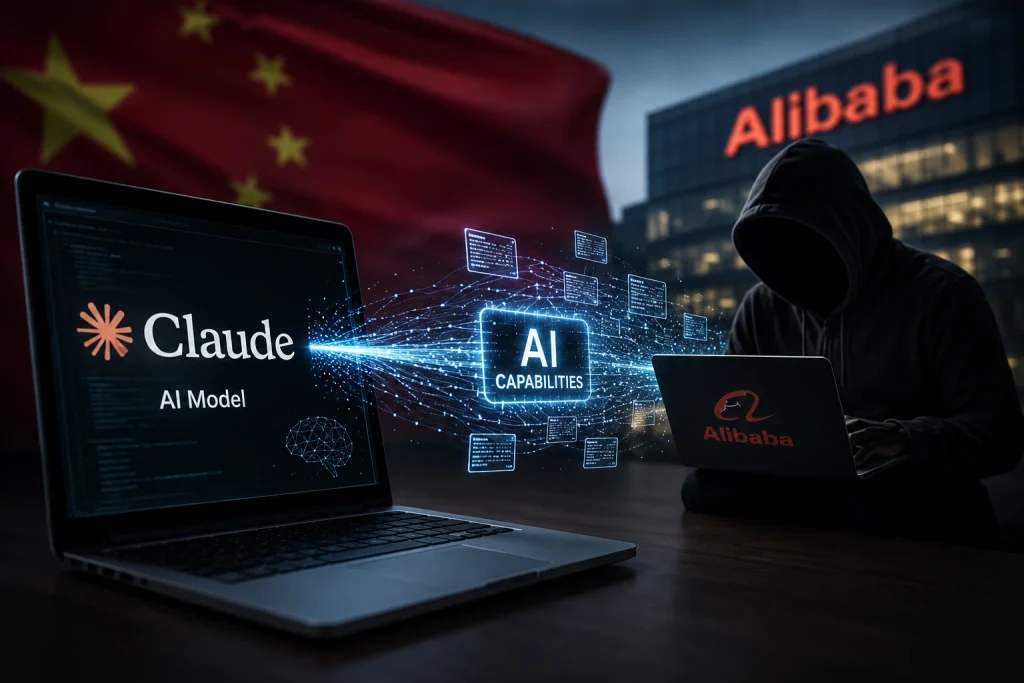
SAN FRANCISCO: Anthropic has accused Alibaba of orchestrating the largest known effort to illicitly extract capabilities from a commercial AI system, alleging that operators linked to the Chinese technology giant ran nearly 29 million interactions with its Claude model through thousands of fraudulent accounts to copy its most advanced reasoning abilities.
The San Francisco-based AI company detailed the allegations in a letter dated June 10 to US Senators Tim Scott and Elizabeth Warren, urging Congress to impose financial penalties on firms engaged in what it called “distillation attacks” a technique that uses outputs from a superior AI system to train a weaker competing model at a fraction of the original development cost.
“Distillation attacks turn hundreds of billions of dollars in American investment and research and development into a massive subsidy for our geopolitical competitors,” Anthropic wrote in the letter, first reported by the BBC.
Claude AI Capabilities
The company described the Alibaba-linked operation as “the largest campaign to extract Claude’s capabilities illicitly,” targeting specifically Claude’s ability to handle complex tasks and its underlying decision-making processes the features that represent the most expensive and time-consuming elements of frontier AI development.
US-China AI Rivalry
The accusation lands at a moment of acute sensitivity in the US-China technology rivalry. Anthropic also referenced US Department of Defence assertions that Alibaba, along with BYD and Baidu, maintains ties to the Chinese military a claim all three companies have denied. Alibaba has separately filed a lawsuit to remove itself from a US government blacklist.
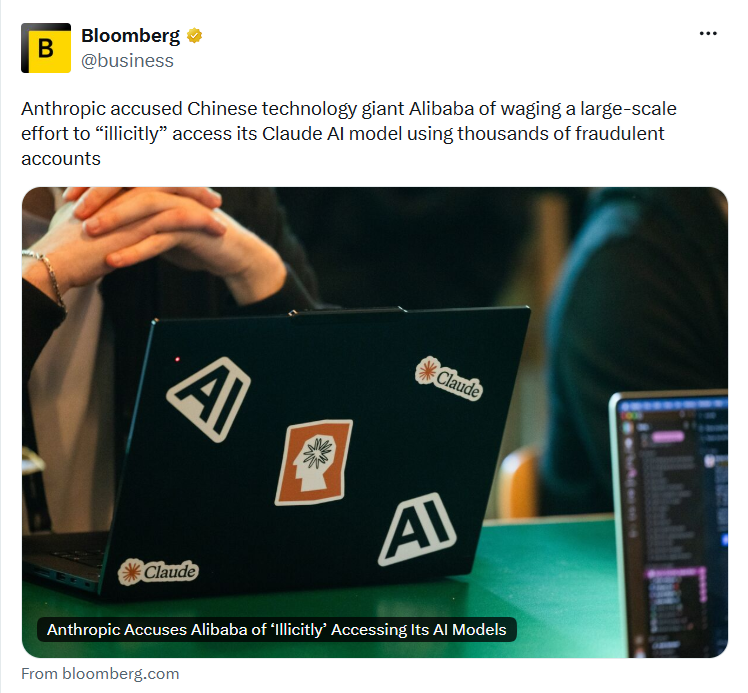
AI Distillation Attack
Distillation as a training technique is not inherently illegal. AI researchers routinely use it to compress large models into smaller, more efficient ones. What Anthropic alleges, however, is something categorically different: industrial-scale extraction of proprietary capabilities through systematic deception, using fraudulent accounts to circumvent the usage restrictions that govern its commercial API.
Also Read: WhatsApp New Security Feature Exposes Scammers Before You Even Reply
If the scale Anthropic describes holds up to scrutiny 29 million interactions across thousands of fake accounts it would represent a qualitatively new phase in AI capability competition, where the product of years of research and billions in capital can theoretically be approximated through coordinated querying rather than independent development.
The letter’s timing carries commercial and political weight simultaneously. Anthropic is preparing for a potential public listing alongside other leading AI developers, making the protection of its intellectual property central to its valuation story. Framing the Alibaba activity as theft rather than competition also strengthens the company’s case before Congress for regulatory intervention specifically, penalties that would raise the cost of running similar operations against US AI systems.
OpenAI has previously raised similar concerns about Chinese entities using distillation techniques to train competing models, suggesting the tactic has become a recognised threat vector across the US AI industry rather than an isolated incident.
Alibaba has not responded publicly to Anthropic’s specific allegations as detailed in the Senate letter.
The episode underscores a structural vulnerability that neither regulation nor technical countermeasures has yet solved: the outputs of the world’s most powerful AI systems are, by commercial design, accessible to anyone willing to pay for API access and distinguishing a legitimate user from one systematically harvesting capabilities at scale remains an unsolved problem for every major AI developer.