

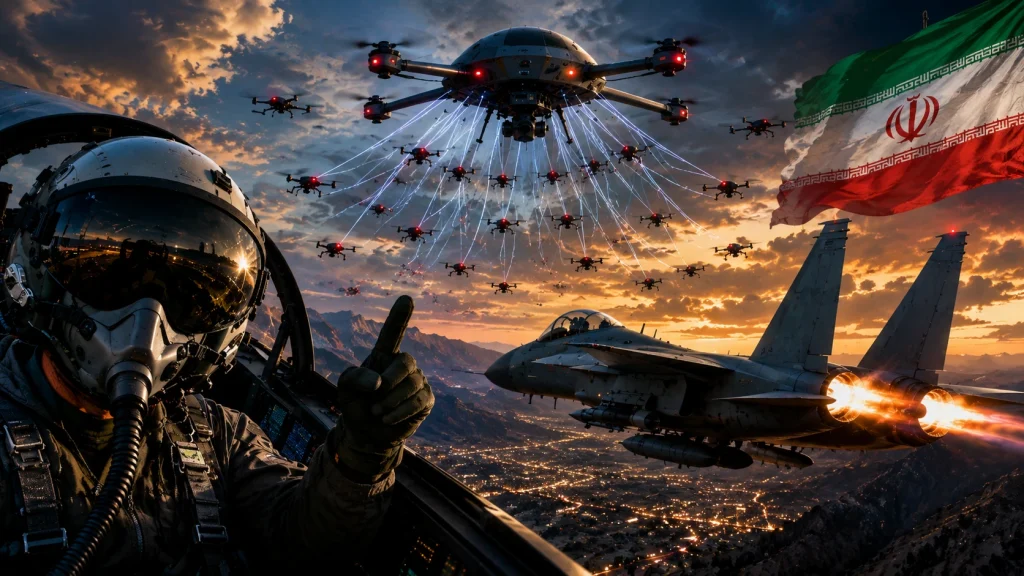
WASHINGTON: A US fighter pilot rescued by special forces after his F-15 Strike Eagle went down over Iran in April delivered testimony during his intelligence debriefing that sent shockwaves through the American national security establishment. He saw a swarm of Iranian drones arrange themselves into a jellyfish-like formation moments before his jet fell from the sky.
The account, reported exclusively by CNN and sourced from four officials familiar with the matter, immediately triggered a firestorm of debate within the US intelligence community that remains unresolved.
Iran Jellyfish Drone Swarm Claim
The pilot told intelligence officials he observed “multiple Iranian drones, moving as one” during his post-rescue debriefing. One source familiar with the account described the pilot’s words verbatim: “Multiple drones interconnected and moving as one with smaller drones below the bigger drones like legs real alien stuff.” A separate source said the pilot described the spectacle as a “minefield of drones” suspended in the sky.
Also Read: Pakistan Set to Acquire 40 Chinese J-35 Stealth Jets — A Direct Challenge to F-35 Power
The testimony represents more than a dramatic battlefield account. It points to a technological capability coordinated drone mesh networking at combat scale that US intelligence agencies had never attributed to Iran.
Drone Network Mystery
The technical term for the capability the pilot described is “one-to-many meshed networking,” which allows a single operator to command multiple drones simultaneously as a unified system. If Iran has operationalised this at the level the pilot described, it fundamentally changes the threat calculus for every US aircraft operating in the region.
The exact cause of the F-15 downing is still under investigation, but initial reports raised the possibility that the drone formation had in some way enabled Iran to shoot down the American jet. The aircraft marked the first US fighter lost over Iranian territory during the war.
Both the pilot and the weapons systems officer aboard ejected. The pilot received rescue within hours of the shootdown, while the weapons systems officer spent more than a day evading Iranian capture in mountainous terrain before US commandos extracted him in a separate operation. A second aircraft an A-10 Warthog went down during the rescue effort, though that pilot ejected safely outside Iranian airspace.
Intelligence Doubts Persist
US intelligence officials, however, approached the account with caution. The pilot suffered a concussion in the crash, and it was the second time he had been shot down during the Iran war, he was among the pilots downed earlier in a friendly fire incident involving Kuwaiti forces. Intelligence debriefers reportedly pressed him: “Are you sure you saw what you are saying you saw?”
Also Read: Pakistan Unveils Rasoob-250 Stealth Cruise Missile With 350km Range and Sub-5m Accuracy
The scepticism is understandable, but the implications of dismissing the account carry their own risks. One drone warfare expert told CNN the US military would spend enormous resources “a lot of blood and treasure” defending against a system capable of coordinating at that level. “If it can coordinate itself into a recognizable shape and maintain that shape, and if it’s got explosives on board, and if it is holding resources in reserve to attack whatever the first volley didn’t destroy that’s a very capable approach,” the expert said.
Iran Drone Technology Questions
There is a documented trail indicating Iran received assistance in developing its drone technology from both China and Russia, according to two sources familiar with the matter. Analysts note that drone swarming and mesh networking research sits at the core of both nations’ military technology programmes, and the transfer of even partial capabilities to Tehran would explain a sudden leap in Iranian drone sophistication.
Iran had previously demonstrated loitering surface-to-air missiles a category of weapon that blurs the line between a kamikaze drone and a conventional SAM though no confirmed use in swarm configurations had been reported before this account emerged.
The disclosure lands at a sensitive diplomatic moment. The US and Iran entered a 60-day window for ceasefire talks last week, with negotiations expected to centre on Iran’s nuclear programme alongside a range of other unresolved issues. Whether Washington factors the drone revelation into those talks or buries it pending further investigation now becomes a question with consequences well beyond the battlefield.