




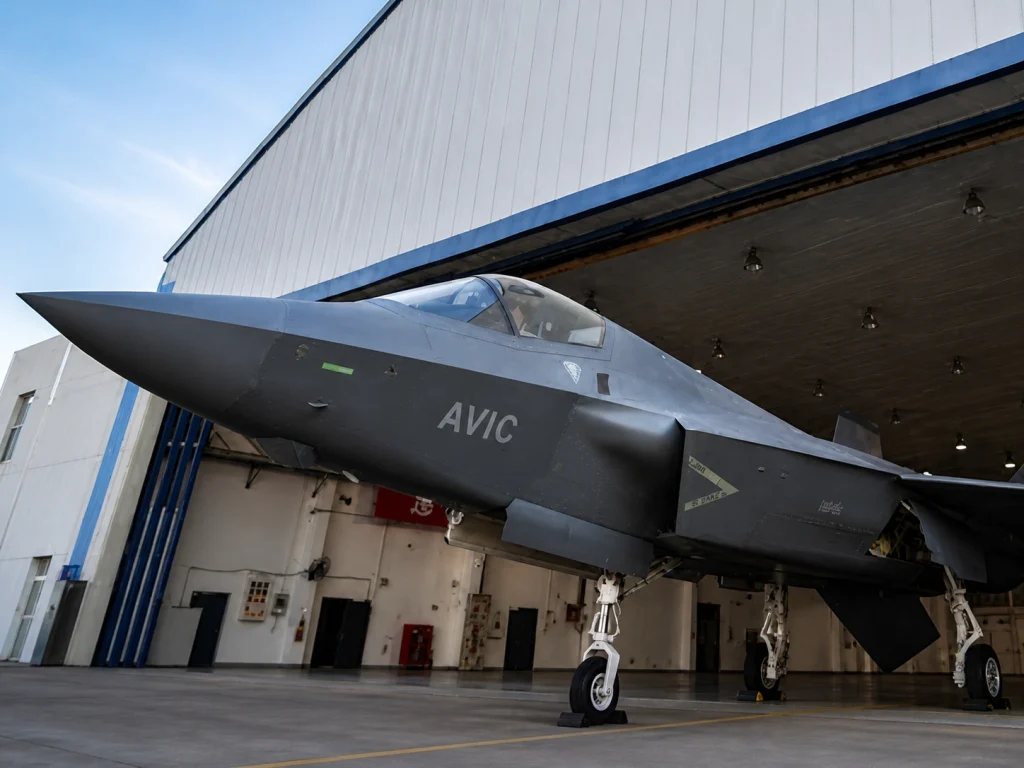
China has taken the initiative. Aviation Industry Corporation of China has finally launched the J-35AE, which is essentially the export version of its next generation stealth fighter jet, during a time when the appetite for modern airpower is growing amongst countries that Western manufacturers have deliberately excluded from the global market of stealth fighter jets. This move was certainly not by coincidence. As reported, Pakistan’s Air Force seems to be leading the pack in acquiring around 40 such aircraft.
Direct Threat to F-35’s Predominance
J-35AE enters a competitive market in the form of the F-35 Lightning II from America, which holds the position of the best fifth-generation stealth multirole fighter plane in the world. Although the F-35 is favored all around the world because of its huge clientele from allied Western nations, the F-35s export possibilities are limited due to the United States’ foreign policy considerations and geopolitics.
The J-35AE fighter jet produced by China fills this void. For defence officials in politically neutral states, China provides a realistic route to stealth through the use of fifth generation capabilities, cost-effectiveness, and lack of political strings attached to Western military equipment sales.
Pakistan as the Launch Customer
The purchase of the J-35AE by Pakistan is justified by the long-term military cooperation between China and Pakistan along with the current modernization efforts pursued by the Pakistani Air Force. Reports about Pakistani pilots’ training and actual procurement talks have it that Pakistan is considering the procurement of up to 40 J-35AE fighter jets to improve their air defense capabilities. Should such news be true, it will mean that Pakistan would be the first nation other than China to field fifth-generation stealth fighters.
The deal will have immense strategic significance for the entire region as well. For India, who already uses Russian-made fighters and is now planning to develop its own fifth generation indigenous program, it will mean that it is dealing with a Pakistani air force with stealth capabilities for the very first time. It will mean that the Indian defense planners will need to rethink their whole strategy.
The Export Strategy of China Emerges Clearly
The choice of AVIC to coordinate the export version of J-35AE with an extremely detailed image of the operational version of the J-35A complete with electro-optical targeting capabilities indicates a conscious effort on China’s part. It shows that the country isn’t exporting a prototype aircraft for development purposes; instead, it has something ready for export and operational use.
Targeting system pictures have revealed the aircraft’s capability to withstand threats such as infrared tracking, lasers, and even multispectral detection systems. As such systems are used by many air defence forces in the region, this picture confirms that the J-35AE was developed for practical use and not just demonstrations.
ALSO READ: PAF Jets Deployed to Saudi Arabia Airbase Under Defence Pact
Indo-Pacific Airpower Reconfiguration
The unveiling of the J-35AE takes place amid a backdrop of tightening export regulations for sophisticated defence systems by Western powers. China is capitalising on its manufacturing capability, diplomatic malleability, and affordable cost structure to satisfy the requirements of those who cannot obtain equipment from the West or are looking for a partner free of strategic alliance obligations. Such considerations are especially pertinent in the Indo-Pacific region, which is experiencing significant militarisation among several countries.
The appearance of the J-35AE within this setting hastens the trend toward a multipolar dispersion of stealth aircraft capacity, whereby fifth-generation proficiency ceases to be the sole province of Western-aligned nations and their officially sanctioned affiliates.

Focus Pakistan is an independent digital news and media platform dedicated to delivering credible, insightful, and impactful journalism across Pakistan and beyond. The publication covers a broad range of sectors including business, economy, technology, telecommunications, aviation, automotive, infrastructure, energy, tourism, public policy, and national affairs.
Committed to accuracy, transparency, and editorial integrity, Focus Pakistan combines breaking news coverage with in-depth analysis, feature stories, expert commentary, and research-based reporting. The platform aims to provide readers with timely, factual, and balanced information while promoting informed public discourse and responsible journalism.
Through its commitment to high editorial standards, Focus Pakistan strives to be a trusted source of news and analysis for policymakers, business leaders, industry professionals, and the general public.