
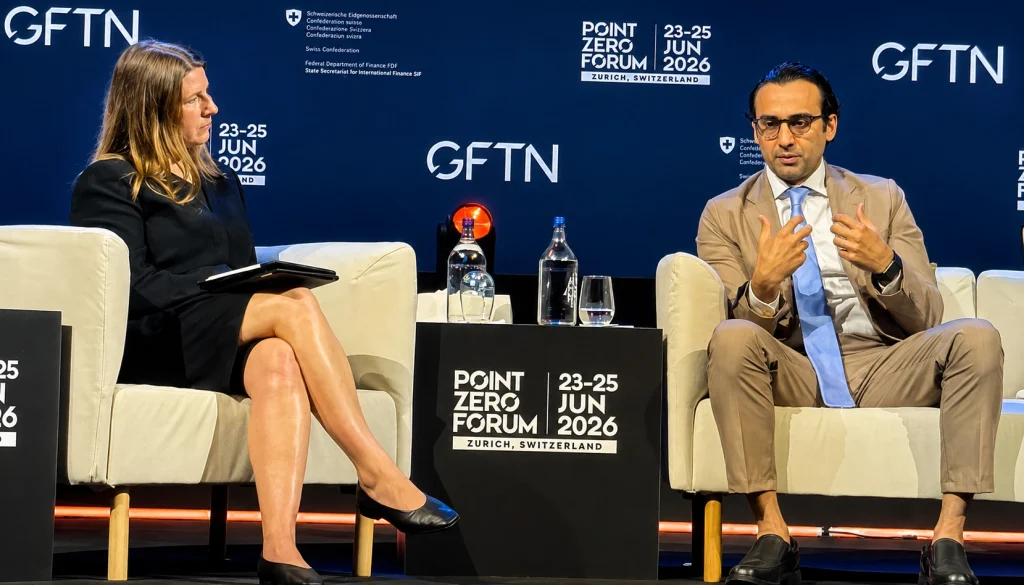
ZURICH: Bilal bin Saqib walked into one of the world’s most exclusive financial forums in Zurich on Friday and told over 2,000 bankers, regulators, and policymakers that Pakistan no longer sits on the sidelines of global digital finance it now demands a seat at the table where the rules get written.
Addressing the Point Zero Forum 2026 the annual policy-technology gathering co-organised by the Global Finance and Technology Network and Switzerland’s State Secretariat for International Finance, themed “A financial system rewired: trust, compliance and protocols in a shifting world” the Minister of State and Chairman of the Pakistan Virtual Assets Regulatory Authority delivered a message that would have seemed unthinkable three years ago: Pakistan ranks third on the planet for crypto adoption, and it intends to leverage that position to shape global digital finance from the inside.
“The rules governing money are being rewritten,” Bin Saqib told the forum. “Pakistan will help write them.”
Pakistan Reaches Global Crypto Top Three
The ranking is not incidental. Pakistan now holds third place on the 2025 Chainalysis Global Crypto Adoption Index, driven by a young population and one of the world’s largest freelancer economies. The country ranks second globally in retail-size crypto transactions and third in centralised exchange activity figures that place it ahead of economic heavyweights including China, Germany, and Japan.
Also Read: Saudi Arabia Eyes Crypto and Blockchain Hub in Karachi
The uncomfortable truth behind those numbers: Pakistan built a top-three crypto market with over 100 million unbanked citizens people with no savings tools, no investment tools, and no conventional path out of their economic class. Crypto filled that vacuum. With around 40 million users and an estimated $300 billion in trading volume, Pakistan already ranks among the fastest-growing crypto adoption markets on earth even as the regulatory framework scrambled to catch up.
Bin Saqib captured that paradox directly at the forum. The question now, he told delegates, is not whether Pakistan permits digital assets. The question is who controls the architecture of digital financial sovereignty and whether emerging economies build that architecture themselves or inherit frameworks designed in Washington and Brussels.
From Regulation to Global Influence
The policy sprint that brought Pakistan to Zurich with something credible to say began in earnest in 2025. Parliament enacted the Virtual Assets Act 2026, building on a 2025 ordinance, formally regulating Pakistan’s virtual asset sector and establishing PVARA as the dedicated national regulator. Unlicensed operators now face regulatory action, including fines and penalties. PVARA has started issuing No Objection Certificates to international exchanges including Binance and HTX. The State Bank subsequently lifted banking restrictions that remained in place for nearly eight years banks can now service PVARA-licensed entities under strict anti-money laundering and counter-terror financing conditions.
Why Stablecoins Matter Now
The government also moved on stablecoins and tokenised money two instruments Bin Saqib specifically addressed in Zurich, positioning Pakistan as a potential test case for cross-border digital payment infrastructure across the developing world.
The 2026-27 federal budget simultaneously proposes bringing digital assets explicitly into the tax framework, with discussions on rates ranging from 10 to 30 percent, subject to amendments to the Income Tax Ordinance.
Pakistan First Crypto Strategy
Bin Saqib’s positioning in Zurich carries diplomatic weight that extends beyond regulatory ambition. Pakistan has turned to cryptocurrency diplomacy to strengthen its relationship with the United States hosting Zachary Witkoff, CEO of Trump-linked World Liberty Financial, in Islamabad earlier this year at a gathering that included Prime Minister Shehbaz Sharif and military chief General Asim Munir. The stablecoin agreement that emerged from that visit remains exploratory, but it signalled something unmistakable: Pakistan’s crypto strategy now operates at the level of foreign policy.
The “Pakistan First” framework Bin Saqib articulated in Zurich means the country controls this industry before it scales it not the reverse. The that PVARA’s next phase focuses on licensing full exchange operations, establishing a digital asset custody framework for state-held assets, and building the regulatory infrastructure to attract institutional capital from the Gulf and Southeast Asia.
“Crypto and blockchain are not a luxury for Pakistan,” Bin Saqib said at an earlier forum. “It’s a ladder for the masses.”
In Zurich on Friday, he told the world Pakistan now holds the ladder and plans to climb to the top.