
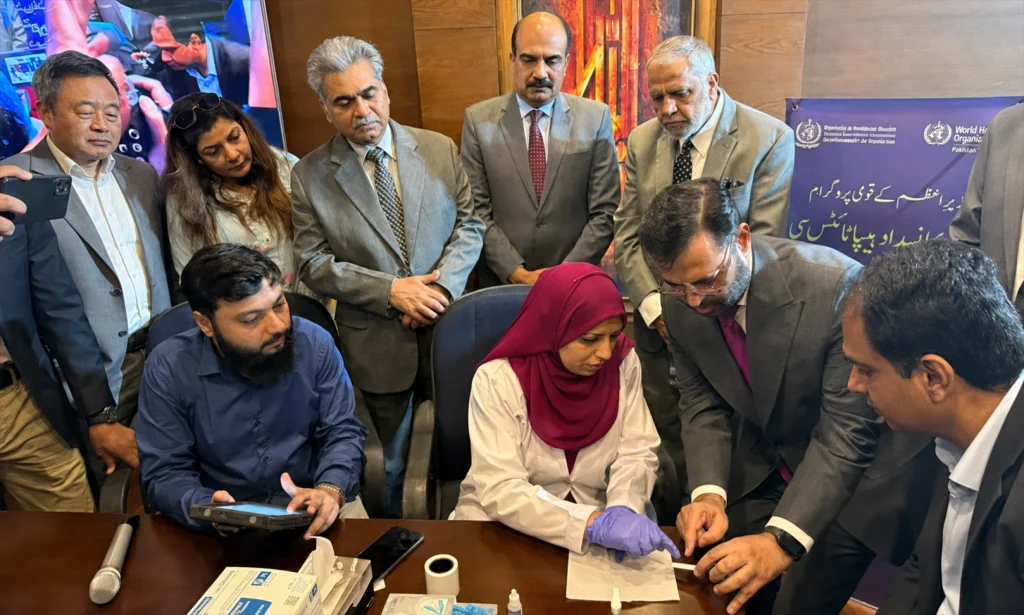
ISLAMABAD: The Ministry of Health and the World Health Organization (WHO) have launched the Prime Minister’s Pakistan Hepatitis C Elimination Program on Wednesday. It is a historic move towards achieving total elimination of the disease as a public health concern in Pakistan by the year 2030.
The project plans to target 1.6 million citizens of the Islamabad Capital Territory during its first six months. The next phase of development will involve expanding the operations to cater to over 164 million people in the country.
A Multibillion-Rupee Investment in Public Health
According to federal minister of health Mustafa Kamal, the government will invest Rs. 67 billion in the health campaign. Speaking at the occasion held in Islamabad, Mustafa Kamal stated that the government will offer a three-to-six-month full treatment program without charging any amount from the patients.
“Pakistan currently faces one of its most daunting health challenges,” Kamal stated. He disclosed that there were about 10 million out of 60 million people in the world suffering from the hepatitis C virus residing in Pakistan. What is alarming is that close to 80% of those patients do not even know that they have the disease.
Shifting from “Sick-Care” to Healthcare
Early intervention is crucial to avoid such fatal diseases as liver cancer, according to the minister. There was need for a major change in the national perspective towards medicine.
“The true meaning of healthcare is to prevent people from becoming sick,” Kamal remarked. He explained that the nation needs to move away from what he described as “sick care” to healthcare which emphasizes on prevention.
Authorities will ensure transparency and maximum outreach by integrating the National Database and Registration Authority into the testing process. Officials have already established 12 hepatitis screening counters at federal hospitals in Islamabad for immediate testing and patient facilitation.
Also Read: New Rabies Detection Method Developed at Indus Hospital in Karachi
Screening at No Cost and Financial Assistance
Through the novel initiative, citizens will have access to the screening test that normally costs up to Rs7,000 at no cost. Kamal urged the people to adopt the programme.
Dr. Luo Dapeng welcomed the programme as being instrumental towards meeting global health objectives and cited WHO estimates according to which 850,000 deaths could be prevented in addition to saving one million cases from getting infected.
“WHO is with Pakistan for the implementation of this program,” Dr. Dapeng added. He noted that although testing and treating are essential, preventing is the ultimate answer to solving the problem. The WHO approach includes:
- Mother-to-child transmission prevention.
- Safe administration of medical injections.
- Safe blood transfusion.
- Harm reduction approach.
Pakistan aims to eliminate hepatitis C through massive financial investment, an efficient database system, and expert support from the international community.