
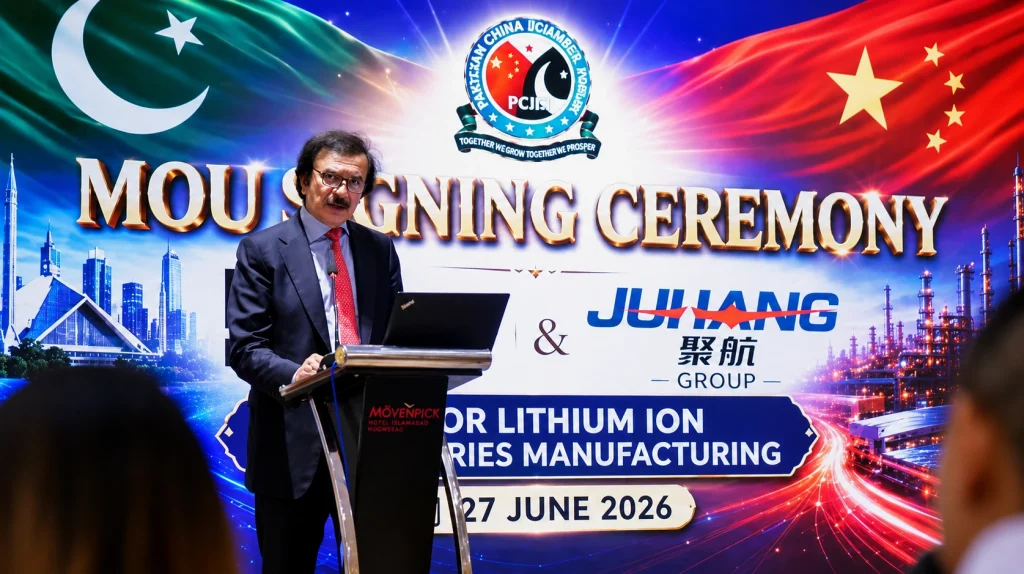
ISLAMABAD: Saigols Group and China’s Hebei Juhang Energy Technology Group signed a memorandum of understanding Sunday to manufacture lithium-ion batteries and electric vehicle charging infrastructure inside Pakistan, a deal that Special Assistant to the Prime Minister Haroon Akhtar Khan called the opening shot of a new industrial era.
The signing, held at a local hotel, brings together one of Pakistan’s oldest industrial houses and a Chinese energy technology firm specialising in advanced battery systems, clean energy storage and EV infrastructure a combination the government wants to anchor Pakistan’s clean energy supply chain before import dependency deepens further.
Saigols Group Battery Project
Pakistan’s solar adoption has outrun its storage capacity. Households and businesses across the country now generate electricity they cannot bank, selling it back to a grid already struggling under its own contradictions or simply losing it. Locally manufactured lithium-ion batteries fix that problem at the source. Hebei Juhang’s technology, sharpened across China’s ferociously competitive clean energy market, gives Saigols something no domestic player currently holds.
Lithium-Ion Battery Manufacturing
Haroon Akhtar Khan made that strategic case explicitly at the ceremony. Battery manufacturing, he told the gathering, sits at the foundation of every serious economy’s transition toward electrified transport and renewable energy. Countries that build this supply chain now own the next industrial generation. Countries that don’t buy from those that did.
Read More: Treet Battery Shakes Up Pakistan’s Energy Market With NeoPower Launch
He pushed the government’s reform credentials hard the National Industrial Policy, the National Tariff Policy, the Regulatory Reform Programme. The pitch was familiar but pointed: Pakistan has historically scared investors away with procedural complexity and policy reversals. Haroon Akhtar Khan argued Sunday that the current administration has structurally changed that calculus.
“We are replacing red tape with red carpets for investors,” he said.
Government’s Industrial Vision
The proposed manufacturing facility, once operational, targets import substitution first and export-oriented production second. Local battery assembly generates engineering jobs, pulls component suppliers into its orbit and builds indigenous technical capability that Pakistan has repeatedly attempted and repeatedly failed to sustain across other industrial sectors.
Saigols Group carries the credibility of longevity in Pakistani industry. Hebei Juhang carries technology Pakistan does not yet possess. The MoU marries both. What it does not carry, yet, is a construction timeline, a committed capital figure or a regulatory clearance the three variables that separate Pakistan’s long shelf of signed agreements from the shorter list of factories that actually opened.
Haroon Akhtar Khan acknowledged none of that Sunday. His job was to celebrate the signing, frame it inside Prime Minister Shehbaz Sharif’s industrial transformation narrative and send investors a signal that Pakistan remains open, serious and worth the risk.
The signal landed cleanly. Whether Hebei Juhang and Saigols follow it with steel and machinery is the part Pakistan’s industrial history has yet to get right consistently.

Focus Pakistan is an independent digital news and media platform dedicated to delivering credible, insightful, and impactful journalism across Pakistan and beyond. The publication covers a broad range of sectors including business, economy, technology, telecommunications, aviation, automotive, infrastructure, energy, tourism, public policy, and national affairs.
Committed to accuracy, transparency, and editorial integrity, Focus Pakistan combines breaking news coverage with in-depth analysis, feature stories, expert commentary, and research-based reporting. The platform aims to provide readers with timely, factual, and balanced information while promoting informed public discourse and responsible journalism.
Through its commitment to high editorial standards, Focus Pakistan strives to be a trusted source of news and analysis for policymakers, business leaders, industry professionals, and the general public.