

PESHAWAR: Khyber Pakhtunkhwa plans to eliminate every cash counter at every government office by September 1, targeting Rs29.4 billion in additional annual revenue through a province-wide mandate that will force citizens to pay all government dues digitally or not at all.
The KP government’s initiative, anchored in the Chief Secretary’s Good Governance Programme, covers 172 person-to-government payment streams across 34 departments, and makes KP the only province in Pakistan to enforce a complete ban on cash at public counters. No other provincial government has attempted anything on this scale.
KP Digital Payments Rollout
The numbers driving the push tell the story bluntly. KP currently pulls Rs42 billion a year in direct public revenue. That cash counters drain that figure by letting money vanish without an audit trail. He said every rupee today passes through a human hand, creating opportunities for leakage that the province has decided to shut permanently.
Also Read: Islamabad Opens Women-Only Enterprise Market in G-11 With Cashless Digital Payment System
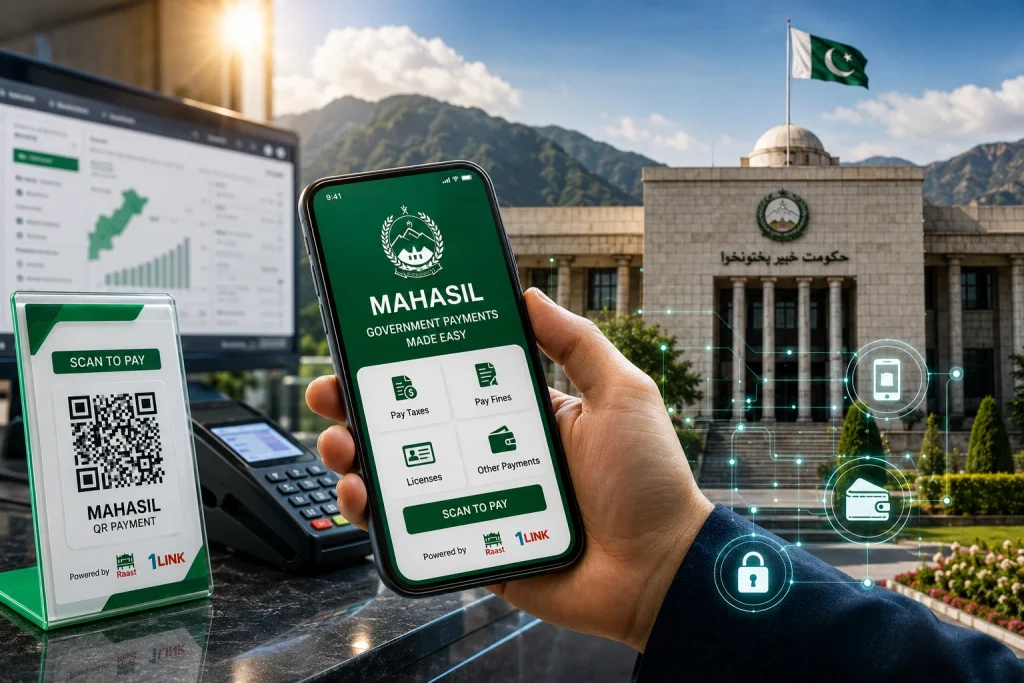
Dr Akif Khan, managing director of KP Information Technology Board, said the transition runs through two channels: direct integration of Raast and 1-Go digital payment platforms, and a dedicated mobile application called Mahasil an Urdu word for revenue. QR codes at government counters will let citizens scan and pay without touching paper money or queuing before a clerk.
Cash Counters Face Deadline
KPITB has already digitally enabled 148 of the 172 target payment heads. It is processing the remaining 22. Another 300 services outside the main government treasury framework are also moving onto the platform.
The revenue projections carry weight because KP has already tested the model. After KP Revenue Authority went fully cashless, fines collected by assistant commissioners generated Rs378 million in 2025 against Rs223.7 million in 2023 a 69 per cent surge despite the number of fines collected actually falling. Arms licence revenues climbed from Rs1.45 billion in 2022 to Rs2.50 billion by 2025, a 72.7 per cent jump the government attributes entirely to removing cash from the equation.
Rs29 Billion Revenue Target
The official said Finance Act 2026 will amend KP’s financial rules to give the entire digitisation drive legal backing, closing any regulatory gaps before the September deadline.
KP’s own internal projections show a steep revenue curve: 5 per cent digital adoption yields Rs2.1 billion in new revenue, 50 per cent adoption delivers Rs21 billion, and crossing 70 per cent unlocks the full Rs29.4 billion target nearly doubling the province’s current direct revenue base.
Beyond account-1 services, 698 services across autonomous bodies, local governments, and public corporations also face the shift. Agreements for 637 of them are already signed. KPITB has physically received 218 service files, with 480 still pending transfer. To relieve pressure on KPITB, the government will route 122 entities directly through commercial banks.