


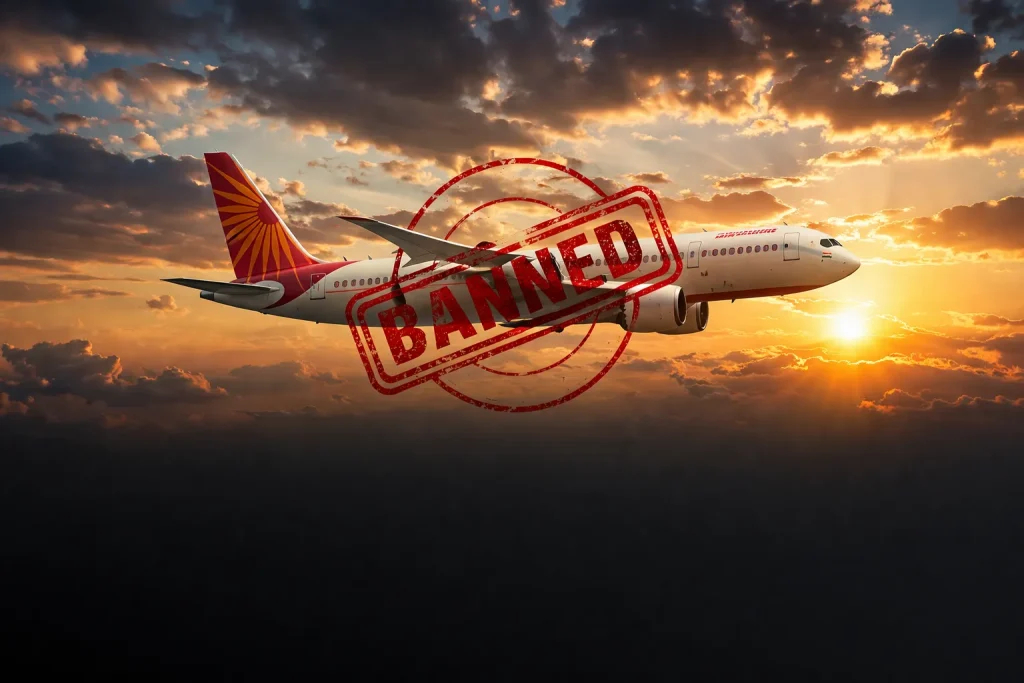
Pakistan airspace ban on Indian flights has crossed the one-year mark, costing airlines nearly $800 million while forcing longer routes, higher fuel consumption, and rising ticket prices.
KARACHI: The latest NOTAM issued by the PAA states that no flights coming from India, Indian airlines, and military aircrafts will be allowed to fly within the Pakistani airspace up until May 24. This is a continuing ban which rolls over for the month and has gone past its year-long mark since being implemented from April 24, 2025.
Pakistan Airspace Ban Crosses One Year
The figures speak for themselves. According to industry estimates, the total yearly loss for India’s airlines stands at ₹7,000 crores ($800 million), caused by longer routes, high fuel costs, and canceled flights. Air India bleeds the hardest. The Tata Group-owned carrier formally wrote to the Civil Aviation Ministry on April 27, 2025, warning that the airspace closure hits it disproportionately due to its extensive international network, citing “additional fuel burn and additional crew” costs. The airline projected losses exceeding ₹50 billion roughly $591 million for every year the ban remains in force, and formally requested a government subsidy model to absorb the blow.
Also Read: Ethiopian Airlines to Launch Lahore Flights, Unlocking Pakistan–Africa Trade Corridor
IndiGo faces its own reckoning. India’s largest carrier stares at projected annual losses of ₹1,300 crore, while flight costs on individual sectors have jumped by $1,350 to $3,000 per flight due to higher fuel consumption on longer detours.
Indian Airlines Face Massive Financial Losses
The operational disruption hits passengers just as hard as balance sheets. The figures speak for themselves. According to industry estimates, the total yearly loss for India’s airlines stands at ₹7,000 crores ($800 million), caused by longer routes, high fuel costs, and canceled flights. None of them is now using the shortest route anymore.
A flight on the IndiGo Delhi to Tashkent route, which would take only 2 hours and 18 minutes with a straight route, now takes around 5 hours and 30 minutes via Iran and Turkmenistan, thus taking more than twice the time it would normally take. Air India’s North American long-haul flights from Delhi lost their efficient polar routing entirely and now require mandatory fuel stops, with Vienna and Copenhagen absorbing most of that extra traffic adding three to six hours to total journey times.
A flight that once took three and a half hours from Delhi to Tbilisi now takes nearly seven hours, while IndiGo has suspended its flights to Almaty and Tashkent because these routes now exceed the aircraft’s operational range.
Fares Rising, Rivals Gaining
The air transport industry is expecting price increases of between 8 to 12 percent to counter the rising costs, a challenge that is squarely facing the Indian consumer. On the other hand, Gulf-based airlines, including Emirates, Etihad Airways, and Qatar Airways, have taken advantage of the lost market share by Indian airlines.
No Diplomatic Off-Ramp in Sight
Pakistan’s Civil Aviation Authority has extended the closure repeatedly every month, with analysts noting the ban carries more political symbolism than strategic utility especially as Pakistan‘s own aviation authorities absorb revenue losses from foregone Indian overflight fees.
The Indian government continues exploring alternatives, including negotiating Chinese airspace overflight clearances and approving extra pilots on ultra-long North American sectors to manage fatigue on extended routes. Neither of these alternatives gets rid of the fundamental expense.
Unless diplomacy succeeds in finding a solution, each successive extension of the NOTAM will result in higher fuel costs, wasted time, and additional expenses for a sector that has not fully recovered from the pandemic crisis. Pakistan keeps signing the NOTAMs. India’s airlines keep paying the price.

Focus Pakistan is an independent digital news and media platform dedicated to delivering credible, insightful, and impactful journalism across Pakistan and beyond. The publication covers a broad range of sectors including business, economy, technology, telecommunications, aviation, automotive, infrastructure, energy, tourism, public policy, and national affairs.
Committed to accuracy, transparency, and editorial integrity, Focus Pakistan combines breaking news coverage with in-depth analysis, feature stories, expert commentary, and research-based reporting. The platform aims to provide readers with timely, factual, and balanced information while promoting informed public discourse and responsible journalism.
Through its commitment to high editorial standards, Focus Pakistan strives to be a trusted source of news and analysis for policymakers, business leaders, industry professionals, and the general public.