



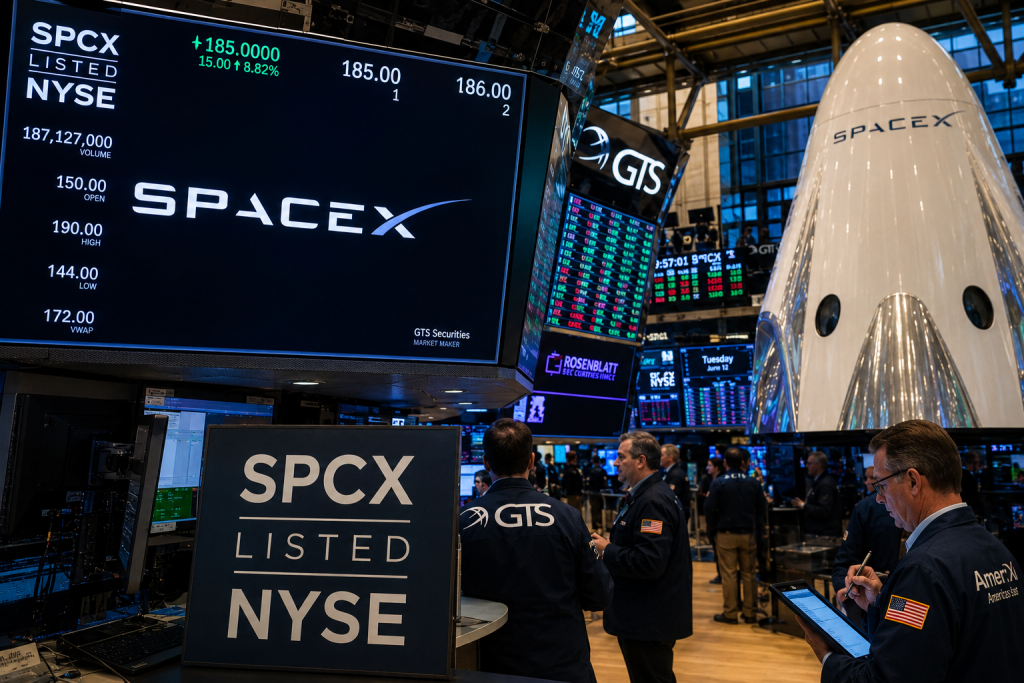
SpaceX shares closed at $185 on June 18, capping a debut week that turned a $1,000 investment at the $135 IPO price into $1,370, even as the stock shed 8.3% over two consecutive sessions. The company listed on the Nasdaq under ticker SPCX on June 12 at $150 per share. It then rebounded to its new record high of $225.64 on June 16, resulting in SpaceX’s market valuation reaching $2.96 trillion. The rebound was quickly followed by a sharp fall in the next two days: On June 17, the price dropped 4.95% to close at $191.82 and then fell further 3.56% on June 18 to end at $185.

SpaceX Stock Delivers 37% Gain in Debut Week
SpaceX still closed the week 37% above its IPO price. The company’s market capitalisation stood at $2.44 trillion on June 18, exceeding its opening valuation of $1.77 trillion by about $670 billion.
A thin public float fuelled much of the week’s volatility. SpaceX released only 4% to 5% of total shares into public trading, well below the 15% to 25% that companies typically offer in a standard IPO. Elon Musk holds over 82% voting control after the offering. This scarcity of tradable shares drove the stock toward $225.64 and then magnified the subsequent pullback.
tradable shares drove the stock toward $225.64 and then magnified the subsequent pullback.
SpaceX Faces New Challenges After Listing
Two announcements triggered the sell-off, Focus Pakistan learnt from a review of market disclosures. SpaceX confirmed a $60 billion all-stock deal to acquire AI coding startup Cursor just days after listing, a move that immediately diluted shareholders who bought on the open market. Bloomberg also reported that SpaceX bankers are preparing a separate $20 billion bond sale, a disclosure that drew questions from analysts about why a company that just raised $75 billion needs additional debt.
Also Read: Elon Musk Makes History as World’s First Trillionaire After SpaceX Debut
Options contracts were introduced by Nasdaq on June 17 in SPCX which provided the short sellers with their first avenue to trade on the decline in the price of this stock. During the entire year 2025, SpaceX Corporation registered a net loss that stood at 4.9 billion dollars relative to the profits realized during 2024. The reason why SpaceX Corporation recorded such losses is due to xAI’s operations which lost 6.36 billion dollars as against capital expenditure of 12.7 billion dollars. The revenue generated by SpaceX Corporation in the first quarter of 2026 stood at 4.69 billion dollars while Amazon recorded revenue of 181 billion dollars with net income at 30 billion dollars.
Can SpaceX Stock Sustain Its Momentum?
Wall street analysts have now assigned price target ranges for SPCX stocks from $62 to $401 since there are conflicting views on whether xAI can be profitable. SpaceX also qualifies for fast-track entry into the Nasdaq-100 within 15 trading days of its June 12 listing. Bloomberg Intelligence estimates this inclusion could draw roughly $600 billion in passive index-fund buying once it takes effect.
Insider lock-up restrictions will start easing in stages from late July or early August, coinciding with SpaceX’s second-quarter earnings release. The standard 180-day lock-up expires near December 2026, while Musk’s roughly 6.4 billion shares remain locked until June 2027. SpaceX currently keeps 96% of its total shares off the market, and any acceleration of insider selling later this year could retest the thin-float dynamics that defined the stock’s first week.

Faraz Ali Ansari is the Founder & Editor of Focus Pakistan and Founder & CEO of Focus Public Relations. With more than 22 years of experience in journalism, media relations and strategic communications, he covers business, economy, aviation, technology, public policy and corporate affairs. He has worked with leading national and international organizations across multiple sectors.