
Turkey Reveals Hypersonic Monster Missile That Could Reach Europe in Minutes
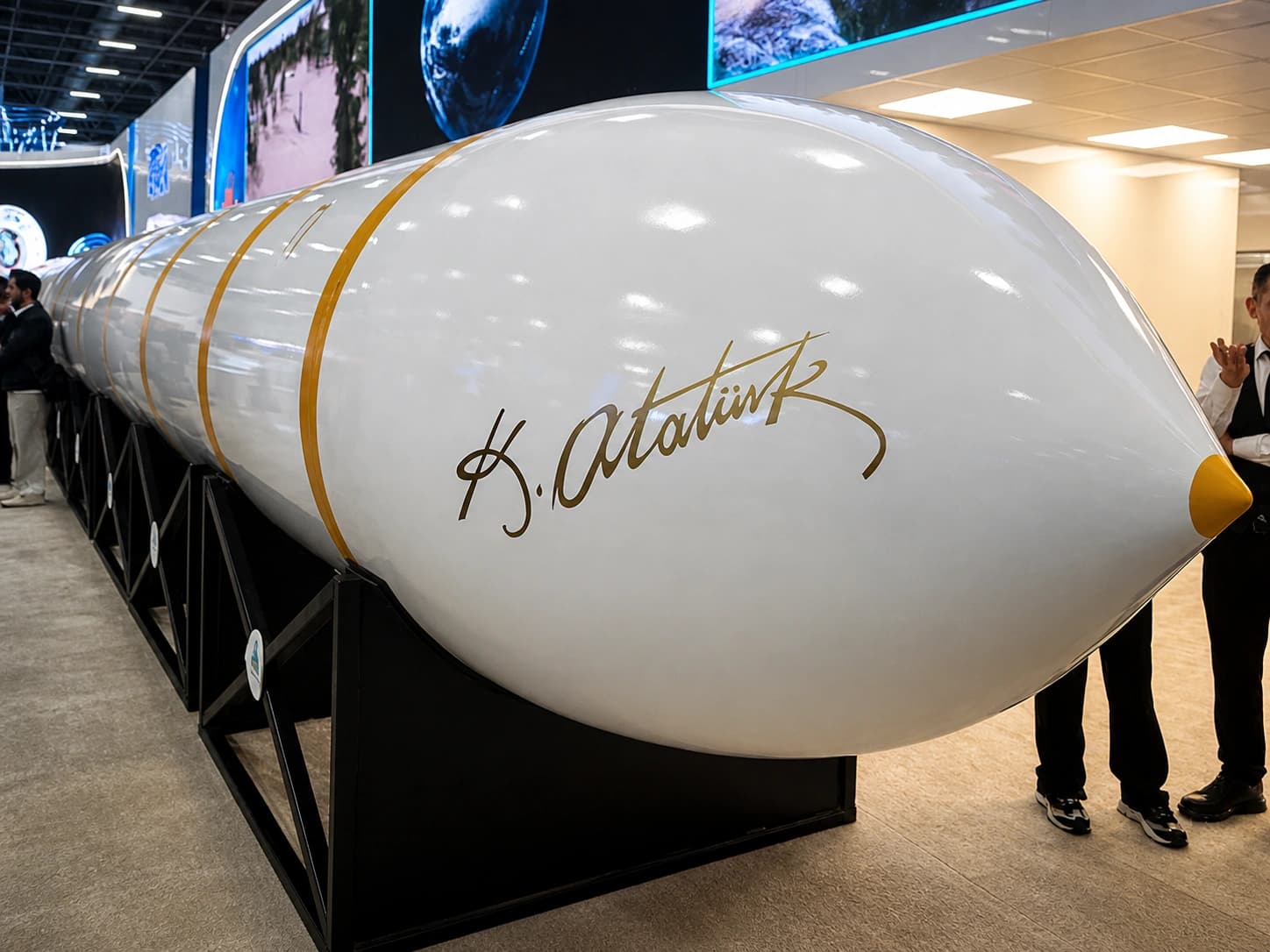
Tuesday was an important day for Turkey, as the country announced its entry into a league of countries with an intercontinental ballistic missile by presenting its newly developed weapon, known as the Yıldırım Khan, at the International Defense and Aerospace Show SAHA 2026 in Istanbul. The Yıldırım Khan is yet another addition to a select few of countries that own an ICBM, and this new development has some serious implications for defense experts and other stakeholders.
This missile is capable of traveling at speeds as high as Mach 25, which is 25 times the speed of sound, and has an attack range of about 6,000 kilometers. Just these two characteristics put it at the top end of ICBM capabilities around the world, and comes from a country that was reliant on foreign supplied weaponry only ten years ago.
The fuel used by the ICBM is liquid nitrogen tetroxide, and the propulsion is provided by four rocket engines.
The Yıldırım Khan missile was designed and manufactured domestically by Turkey’s Ministry of Defence Research and Development Institute. This information holds as much importance as the design and technical details of the missile. Liquid nitrogen tetroxide fuel powers the missile, which is propelled by four rocket engines operating in harmony with each other.
The Yıldırım Khan’s Mach 25 flight speed poses significant challenges for air defense systems in today’s generation. Interceptor systems currently in use target threats traveling between Mach 5 and Mach 15, which is considered hypersonic and has already pushed the boundaries of both the Western and Russian air defense systems. The time frame available for dealing with a Mach 25 missile threat is reduced to mere seconds from minutes for any country within the range of the Yıldırım Khan’s 6,000 kilometers.
SAHA 2026 becomes the world stage for Turkey’s largest defence announcement
The selection of SAHA 2026 as the platform to unveil Yıldırım Khan missiles was strategic and purposeful. The SAHA International Defence and Aerospace Exhibition in Istanbul is attended by the top defence firms from Turkey and its international partners and stakeholders, showcasing missile systems, drones, air defense systems, aerospace, and space technology thus becoming the best platform for such an announcement within the country.
With SAHA 2026, Turkey has managed to convey a message that has extended far outside Istanbul’s exposition grounds. By positioning the Yıldırım Khan missile together with other drone projects, anti-aircraft missiles, and aircraft in one expo, Turkey showed that the ICBM project is not only about a breakthrough success but rather represents the main feature of a defense industry system that was formed for decades.
ALSO READ: Istanbul Quad: Turkey, Saudi Arabia, Pakistan, Egypt Forge New Military Power Bloc
Turkey’s plan of defence spending comes to fruition in this manner.
It cannot be said that the Yıldırım Khan missile materialized out of thin air. Over the past decade, Turkey has invested billions of dollars in a highly thought-out process of developing its indigenous defence industry and moving away from dependence on foreign sources of defence equipment. This has resulted in the production of such marvels as the Bayraktar TB2 unmanned aerial vehicle, which redefined modern warfare in Ukraine, Azerbaijan, and all over Africa, the AKINCI high-altitude combat unmanned aerial vehicle, as well as the air defence system HISAR.
It has been observed by analysts monitoring the developments in Turkey’s defense industry that the revelation of the Yıldırım Khan missile comes at a time when the Turkish government is making its heaviest investment in missile technology, unmanned aerial vehicles, air defense, military aircraft, and even space technology.
Yıldırım Khan significance for global defence strategies
With a 6,000km reach, the Yıldırım Khan missile can target Western Europe, the Middle East, Central Asia, and regions of South Asia, requiring every country in the region to reconsider its threat perceptions in light of Turkey's treaty obligations and regional conflicts.
The Yıldırım Khan missile alters the way Turkey approaches all of its negotiations at any table it finds itself at, be it within the scope of NATO, in its bilateral dealings throughout the Middle East, or its increasingly important strategic partnerships stretching from Africa to Central Asia. Countries in its range will revise their assessments of potential threats. Allies will raise inquiries. The discourse on who has the ability to fire intercontinental ballistic missiles will never be the same.



Leave a Reply
Your email address will not be published. Required fields are marked *