



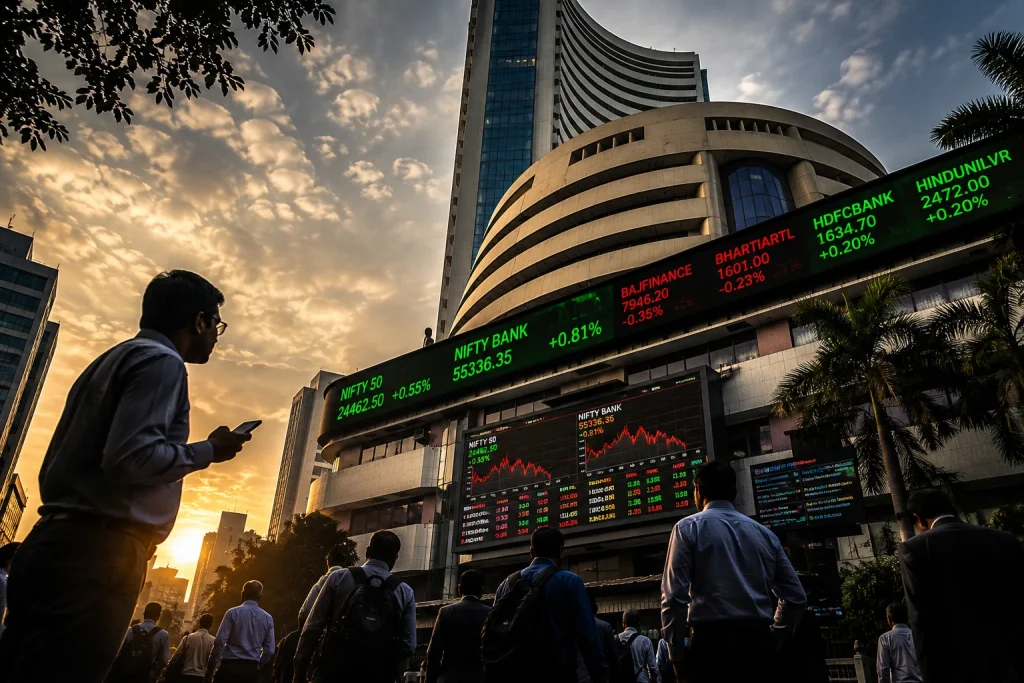
NEW DELHI: Foreign investors yanked Rs2.25 trillion out of Indian equities within the first five months of 2026. That’s already more than last year’s full-year record of Rs1.66 lakh crore. The drop occurred due to India’s stock market falling behind tech-savvy competitors. Plus, policy weaknesses, a weakening rupee, and rising tensions from the US-Iran conflict compounded the issue.
As per NSDL, foreign portfolio investors’ net investments in Indian equities were Rs7.3 trillion as of June 1, the lowest since 2016. This is a major confidence hit for a market often seen as one of the world’s top investment choices, thanks to Modi’s government’s promotion. So, it marks a significant decline in what was once a thriving area for international investment.
Foreign Ownership at 14-Year Low
According to Focus Pakistan, foreign investors’ ownership of listed Indian companies dropped to about 15 percent from nearly 20 percent a decade ago, says JM Financial Institutional Securities strategist Venkatesh Balasubramaniam. Another JM Financial report put the number at 14.7 percent, a 14-year low, versus domestic institutional ownership at 18.9 percent. So, Indian money now outshines foreign investment in their markets.
The scale of the outflow carries historic weight. In just five months, foreign investors took more money out of Indian equities than they did all of last year. It was relentless too—FPIs withdrew ₹35,962 crore in January, then ₹22,615 crore in February. They set a record by pulling out ₹1.17 lakh crore in March, followed by ₹60,847 crore in April, and ₹32,963 crore in May.
India Overtaken by Taiwan and South Korea
India’s fallen out of the top five largest equity markets for market cap, getting passed by Taiwan and South Korea. These tech centers saw huge gains because of global AI and semiconductor needs. Taiwan then reached nearly $5 trillion in market cap, becoming the fifth-biggest equity market on May 26th, right after passing India.
Within a week, South Korea also pushed ahead of India, overthrowing it from sixth place. South Korea’s KOSPI generated approximately 77 percent returns in calendar year 2025 and a further 74 percent in the first 17 weeks of 2026. Taiwan delivered significantly higher returns on the back of TSMC’s earnings, with its broad index up nearly 82 percent since the beginning of 2025.
The AI Trade India Missed
India served as a “funding market” for Asia’s AI boom over the past year, prompting a rotation of capital from Indian stocks into South Korea and Taiwan. Global emerging market fund managers seeking to increase exposure to Taiwan Semiconductor, Samsung, SK Hynix and the broader AI hardware supply chain in Northeast Asia needed to raise cash somewhere and India became that source.
Goldman Sachs noted that compared to North Asian markets, India offers a less attractive risk-reward proposition, trading at significantly higher growth-adjusted valuations, compounded by ongoing investor concerns over the potential adverse impact of AI on India’s dominant IT sector. The bank said earnings revisions in India have become an increasingly important variable guiding foreign flows, adding that “low visibility around a recovery will likely limit foreign re-buying in the near-term.”
Kotak Institutional Equities strategists led by Sanjeev Prasad said the brokerage expects “FPI flows to stay muted, given India’s low attractiveness versus other EM markets,” noting that India’s near-term earnings growth lags commodity– and technology-oriented emerging markets while the country remains largely absent from the AI and semiconductor cycle.
Geopolitical Pressures Compound the Damage
In 2025 and 2026, the MSCI Emerging Markets index, excluding India, beat India’s performance. In 2026, the gap grew because of the Iran conflict. This event hit oil-importing countries harder. Since India imports more than 85% of its oil, sky-high energy costs really hit them. The West Asia tension drove prices up, adding inflation, widening the current account deficit, and making the rupee drop faster.
Market folks tied the steady sell-off to tough global economic winds and high geopolitical risks. They kept pointing to West Asia conflicts, climbing crude oil prices, worrying tariffs, and a stronger US dollar as main reasons.
The Rupee Compounds the Flight
Currency deterioration added a second layer of losses for foreign investors. The rupee rapidly breached the 92, 93, 94 and 95 levels per US dollar, with one reference noting it slipped below 95 then an all-time low. A foreign investor in Indian equities simultaneously bets on stock performance and currency stability. As the rupee weakened, dollar-denominated returns collapsed even where stock prices held, accelerating the exit.
The data collectively paints a picture that goes beyond a cyclical correction. A market that foreign investors once treated as a near-permanent overweight position in their emerging market portfolios now faces a structural reassessment one driven by valuation concerns, absent AI exposure, currency erosion, geopolitical vulnerability, and a global capital cycle that rewards semiconductor economies India simply does not compete in.
Analysts say India’s limited exposure to the AI supply chain, combined with concerns around growth and inflation following the oil shock triggered by the US-Iran conflict, has weakened its appeal relative to competing emerging markets. Until New Delhi addresses those structural gaps or global capital rotation reverses the decade-low in foreign investment may not represent a floor.