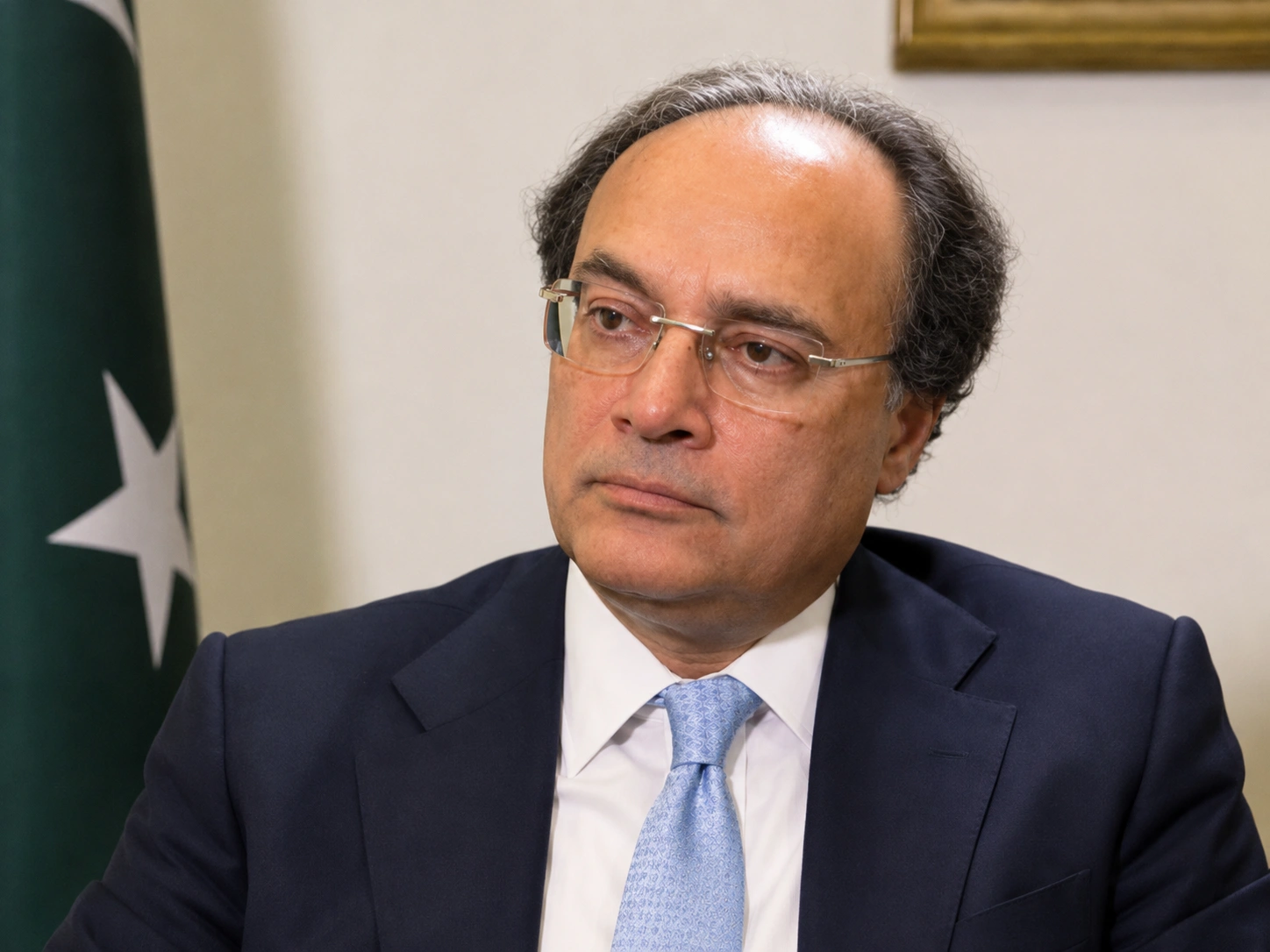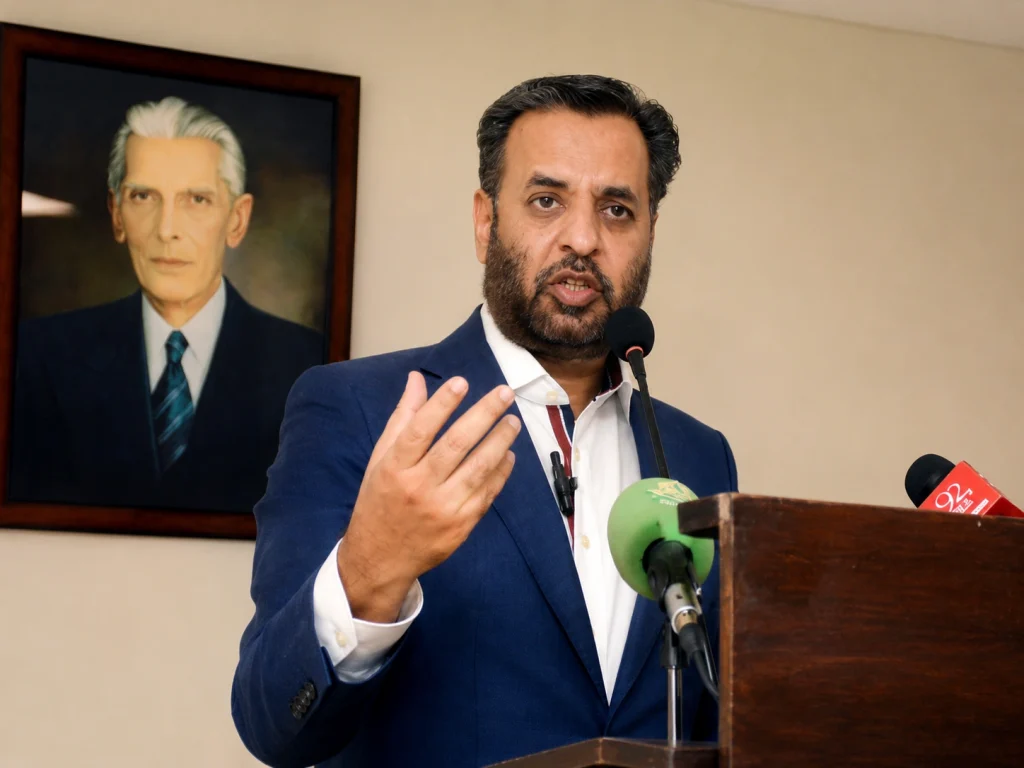



ISLAMABAD: Finance Minister Muhammad Aurangzeb walked into parliament this week carrying a bill that exposes the widest gap yet between the government’s austerity rhetoric and its actual spending behaviour, Rs3.684 trillion in supplementary grants seeking post-facto legislative approval for expenditures already made without parliamentary sanction.
The figure dwarfs the Rs895 billion parliament regularised last year, arriving more than four times larger and raising pointed questions about the credibility of budget estimates across both fiscal years.
Breakdown of FY26 Unauthorized Expenditures
According to Focus Pakistan, the current fiscal year reveals a pattern of spending that prioritizes specific political and administrative projects over standard budgetary limits.
| Category | Overrun Amount | Notable Beneficiaries / Purpose |
| Grants & Subsidies | Rs127.5 billion | Includes the PM’s Austerity Fund. |
| Power Sector | Rs112 billion | Equity injections for distribution companies. |
| Education | Rs57 billion | Daanish Education Trust, university bailouts. |
| Defence Division | Rs34 billion | Helicopter maintenance, border fencing, security duties. |
| Health Services | Rs30 billion | Vaccine procurement for provinces. |
| Information | Rs14 billion | PTV tariff adjustments, English news channel. |
| Political/Development | Rs7 billion | MNA-led development schemes |
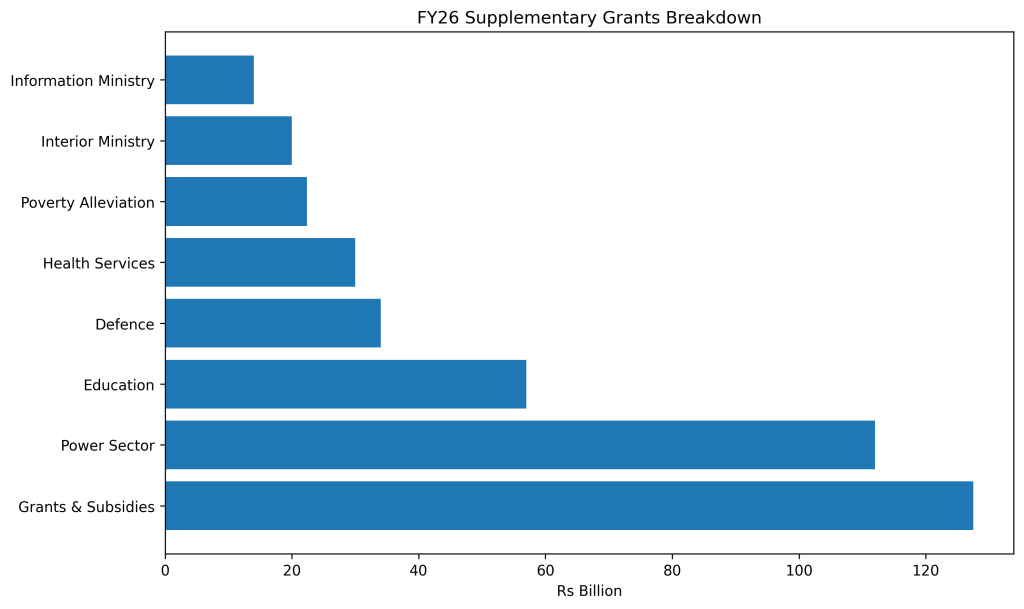
Debt, Power, Defence Lead Overruns
The finance ministry’s own documents, tabled before parliament, show FY25 accounting for the lion’s share Rs3.2 trillion out of the total with Rs2.6 trillion alone going towards debt servicing that exceeded its approved ceiling. Power sector liabilities contributed another Rs430 billion, while grants and subsidies added Rs38 billion. Defence Division and capital works on civil infrastructure overshot allocations by Rs23 billion and Rs22 billion respectively.
Also Read: Pakistan Defence Budget 2026-27 Swells to Rs.3.01 Trillion
The ministry acknowledged that none of these expenditures could wait for formal legislative approval at the time, nor did their nature allow postponement. That argument, however, places parliament in a position where rejection carries no practical consequence the money already gone from the federal consolidated fund.
For the current fiscal year, the ministry seeks approval for Rs485 billion in supplementary grants spanning July 2025 through mid-May 2026. Grants and subsidies top that list at Rs127.5 billion, with the power sector adding Rs112 billion, Rs105.5 billion of that representing equity injected into electricity distribution companies.
Federal education and professional training drew Rs57 billion, nearly all of it Rs54 billion flowing to Daanish Education Trust, bailout packages for Quaid-i-Azam University and Cadet College Hassan Abdal, and the Pakistan Education Endowment Fund. Defence Division claimed Rs34 billion for helicopter spare parts, Pak-Iran border fencing, internal security duties, and naval base development.
PM’s Austerity Fund Itself Needed a Supplement
Among the more striking disclosures: the government channelled Rs127.4 billion through a supplementary grant into the Prime Minister’s Austerity Fund during FY26 a fund whose very title implies restraint. An additional Rs22 billion went to the PM’s Ramazan Package, and Rs7 billion covered MNA development schemes across four provinces and Islamabad.
National Health Services received Rs30 billion for vaccine procurement on behalf of provincial governments. The Interior Ministry drew Rs20 billion, poverty alleviation and social safety Rs22.4 billion, and law and order maintenance an extra Rs15 billion.
Media, Digital Bodies Join the Queue
The Information Ministry secured Rs14 billion, including Rs11 billion linked to PTV tariff adjustments and net-metering and Rs2.8 billion for an English-language news channel. The Pakistan Virtual Assets Authority received Rs800 million, while the Pakistan Digital Authority and Asaan Khidmat Centres collectively drew Rs2 billion. The Federal Board of Revenue took Rs10 billion.
Constitutional Exposure
Articles 80 through 84 of the Constitution require parliamentary authorisation for all federal expenditures. The ministry’s statement concedes that the amounts now before parliament cover two separate periods — May 17 to June 30 of 2024-25 and July 1 to May 15 of 2025-26 both concluded outside the normal budgetary cycle and both legally unsanctioned at the time of spending.
Technical supplementary grants within the package involve re-appropriation between expenditure heads rather than fresh fiscal burden. The regular supplementary grants, however, confirm outright overruns that carry direct additional cost to the public exchequer and parliament, by constitutional design, retains no practical power to reject them once spent.

Focus Pakistan is an independent digital news and media platform dedicated to delivering credible, insightful, and impactful journalism across Pakistan and beyond. The publication covers a broad range of sectors including business, economy, technology, telecommunications, aviation, automotive, infrastructure, energy, tourism, public policy, and national affairs.
Committed to accuracy, transparency, and editorial integrity, Focus Pakistan combines breaking news coverage with in-depth analysis, feature stories, expert commentary, and research-based reporting. The platform aims to provide readers with timely, factual, and balanced information while promoting informed public discourse and responsible journalism.
Through its commitment to high editorial standards, Focus Pakistan strives to be a trusted source of news and analysis for policymakers, business leaders, industry professionals, and the general public.